


Page 72 - Read Online
P. 72
Wang. Soft Sci 2024;4:25  https://dx.doi.org/10.20517/ss.2024.14                 Page 5 of 9

                                                                                     [12]
               optimum doping concentration for maximizing the thermoelectric ZT factor . On the other hand,
               increasing electrical conductivity by enhancing charge carrier mobility has little impact on the Seebeck
               coefficient and is, therefore, a more promising approach in boosting the thermoelectric ZT factor. Organic
               semiconductors typically have strong conductivity anisotropy where the out-of-plane carrier mobility is
               orders of magnitude lower than in-plane conductivity limited by its insulating side chains . One possible
                                                                                            [28]
               way to circumvent the anisotropy limitation on vertical electrical conductivity is to align the organic
               semiconductor and orient their high-mobility in-plane polymer chains perpendicular to the substrate
               [Figure 2A]. As shown in Figure 2A and B, the vertical electrical conductivity of poly(3-hexylthiophene)
               (P3HT) could be improved by several orders of magnitude to around 3 cm ·V ·s  by orienting the in-plane
                                                                                 -1 -1
                                                                              2
               polymer chains perpendicular to the substrate using a mechanical pressing method . Another possibility
                                                                                       [28]
               for small molecule devices is introducing order in the molecules with a novel crystallization method,
               thereby improving the vertical charge carrier transport . The process involves transforming vacuum-
                                                                [29]
               deposited amorphous organic semiconductor thin films into highly ordered organic semiconductor
               crystalline thin films. The thickness of the crystalline film can be tuned by subsequent deposition of
               molecules by epitaxial growth on the formed crystalline template layer. In addition, dopants can be
               introduced during epitaxial growth to introduce free charge carriers and, hence, increase the electrical
               conductivity.


               Another approach to tune the vertical electrical conductivity and other thermoelectric material parameters
               is by blending different materials. Numerous high ZT inorganic thermoelectric materials are developed
               from classic Bi Te  to other emerging Sn-based alloys with ZT factor over 1 . There has been continuous
                                                                                [30]
                            2
                              3
               effort in optimizing the thermoelectric ZT factor through materials composites such as carbon nanotube-
               organic semiconductors and Bi Te -organic semiconductor systems [31-33] . The aim is to achieve a material
                                             3
                                          2
               composite with the best of two worlds, i.e., improve the electrical conductivity by incorporating inorganic
               materials/carbon nanotubes while lowering the overall thermal conductivity by the organic semiconductors.
               In addition, other interfacial effects at the interfaces of the two materials, such as energy filtering and
                                                                                                       [34]
               phonon scattering, could further contribute to improving the thermoelectric device performance .
               Currently, research efforts have focused on improving the thermoelectric ZT factor through the blend
               material system for energy harvesting applications, but this approach would also hold promise for
               engineering the material parameters required for efficient organic Peltier cooling devices.


               Device design considerations
               Apart from optimizing the materials, it is important to consider the device design to achieve optimal
               organic Peltier cooling devices. The geometry of the Peltier cooling modules plays an important role in
               determining the cooling performance of the device. Two dimensionless parameters are used to characterize
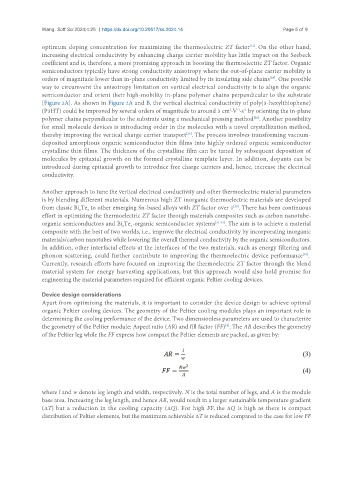
               the geometry of the Peltier module: Aspect ratio (AR) and fill factor (FF) . The AR describes the geometry
                                                                             [8]
               of the Peltier leg while the FF express how compact the Peltier elements are packed, as given by:


               where l and w denote leg length and width, respectively. N is the total number of legs, and A is the module
               base area. Increasing the leg length, and hence AR, would result in a larger sustainable temperature gradient
               (ΔT) but a reduction in the cooling capacity (ΔQ). For high FF, the ΔQ is high as there is compact
               distribution of Peltier elements, but the maximum achievable ΔT is reduced compared to the case for low FF

