


Page 71 - Read Online
P. 71
Page 4 of 9                                Wang. Soft Sci 2024;4:25  https://dx.doi.org/10.20517/ss.2024.14


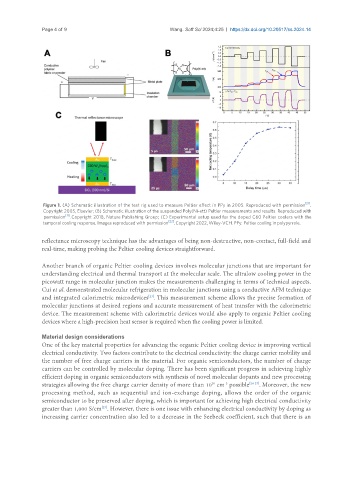
                Figure 1. (A) Schematic illustration of the test rig used to measure Peltier effect in PPy in 2005. Reproduced with  permission [21] .
                Copyright 2005, Elsevier; (B) Schematic illustration of the suspended Poly(Ni-ett) Peltier measurements and results. Reproduced with
                       [11]
                permission . Copyright 2018, Nature Publishing Group; (C) Experimental setup used for the doped C60 Peltier coolers with the
                temporal cooling response. Images reproduced with permission [22] . Copyright 2022, Wiley-VCH. PPy: Peltier cooling in polypyrrole.

               reflectance microscopy technique has the advantages of being non-destructive, non-contact, full-field and
               real-time, making probing the Peltier cooling devices straightforward.

               Another branch of organic Peltier cooling devices involves molecular junctions that are important for
               understanding electrical and thermal transport at the molecular scale. The ultralow cooling power in the
               picowatt range in molecular junction makes the measurements challenging in terms of technical aspects.
               Cui et al. demonstrated molecular refrigeration in molecular junctions using a conductive AFM technique
               and integrated calorimetric microdevices . This measurement scheme allows the precise formation of
                                                   [23]
               molecular junctions at desired regions and accurate measurement of heat transfer with the calorimetric
               device. The measurement scheme with calorimetric devices would also apply to organic Peltier cooling
               devices where a high-precision heat sensor is required when the cooling power is limited.

               Material design considerations
               One of the key material properties for advancing the organic Peltier cooling device is improving vertical
               electrical conductivity. Two factors contribute to the electrical conductivity: the charge carrier mobility and
               the number of free charge carriers in the material. For organic semiconductors, the number of charge
               carriers can be controlled by molecular doping. There has been significant progress in achieving highly
               efficient doping in organic semiconductors with synthesis of novel molecular dopants and new processing
                                                                             -3
                                                                        20
               strategies allowing the free charge carrier density of more than 10  cm  possible [24-27] . Moreover, the new
               processing method, such as sequential and ion-exchange doping, allows the order of the organic
               semiconductor to be preserved after doping, which is important for achieving high electrical conductivity
               greater than 1,000 S/cm . However, there is one issue with enhancing electrical conductivity by doping as
                                   [27]
               increasing carrier concentration also led to a decrease in the Seebeck coefficient, such that there is an

