


Page 171 - Read Online
P. 171
Arab Hassani. Soft Sci 2023;3:31  https://dx.doi.org/10.20517/ss.2023.23         Page 19 of 33


               of mucin as a secreted protein, lithium chloride (LiCl) as an electrolyte, and polyacrylamide (PAAm) as the
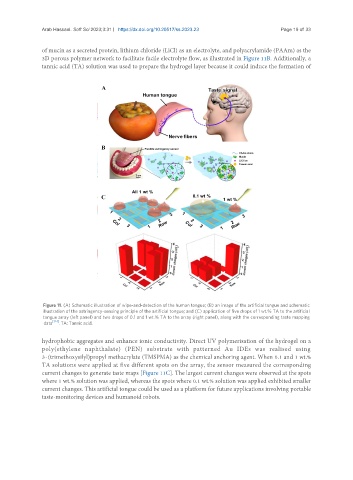
               3D porous polymer network to facilitate facile electrolyte flow, as illustrated in Figure 11B. Additionally, a
               tannic acid (TA) solution was used to prepare the hydrogel layer because it could induce the formation of


                Figure 11. (A) Schematic illustration of wipe-and-detection of the human tongue; (B) an image of the artificial tongue and schematic
                illustration of the astringency-sensing principle of the artificial tongue; and (C) application of five drops of 1 wt.% TA to the artificial
                tongue array (left panel) and two drops of 0.1 and 1 wt.% TA to the array (right panel), along with the corresponding taste mapping
                   [124]
                data  . TA: Tannic acid.

               hydrophobic aggregates and enhance ionic conductivity. Direct UV polymerisation of the hydrogel on a
               poly(ethylene  naphthalate)  (PEN)  substrate  with  patterned  Au  IDEs  was  realised  using
               3- (trimethoxysilyl)propyl methacrylate (TMSPMA) as the chemical anchoring agent. When 0.1 and 1 wt.%
               TA solutions were applied at five different spots on the array, the sensor measured the corresponding
               current changes to generate taste maps [Figure 11C]. The largest current changes were observed at the spots
               where 1 wt.% solution was applied, whereas the spots where 0.1 wt.% solution was applied exhibited smaller
               current changes. This artificial tongue could be used as a platform for future applications involving portable
               taste-monitoring devices and humanoid robots.

