


Page 169 - Read Online
P. 169
Arab Hassani. Soft Sci 2023;3:31  https://dx.doi.org/10.20517/ss.2023.23         Page 17 of 33


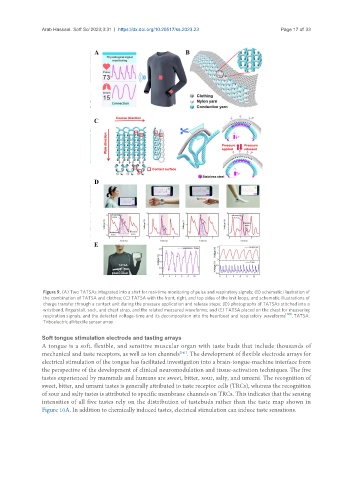
                Figure 9. (A) Two TATSAs integrated into a shirt for real-time monitoring of pulse and respiratory signals; (B) schematic illustration of
                the combination of TATSA and clothes; (C) TATSA with the front, right, and top sides of the knit loops, and schematic illustrations of
                charge transfer through a contact unit during the pressure application and release steps; (D) photographs of TATSAs stitched into a
                wristband, fingerstall, sock, and chest strap, and the related measured waveforms; and (E) TATSA placed on the chest for measuring
                respiration signals, and the detected voltage-time and its decomposition into the heartbeat and respiratory  waveforms [122] . TATSA:
                Triboelectric all-textile sensor array.


               Soft tongue stimulation electrode and tasting arrays
               A tongue is a soft, flexible, and sensitive muscular organ with taste buds that include thousands of
               mechanical and taste receptors, as well as ion channels . The development of flexible electrode arrays for
                                                              [141]
               electrical stimulation of the tongue has facilitated investigation into a brain-tongue-machine interface from
               the perspective of the development of clinical neuromodulation and tissue-activation techniques. The five
               tastes experienced by mammals and humans are sweet, bitter, sour, salty, and umami. The recognition of
               sweet, bitter, and umami tastes is generally attributed to taste receptor cells (TRCs), whereas the recognition
               of sour and salty tastes is attributed to specific membrane channels on TRCs. This indicates that the sensing
               intensities of all five tastes rely on the distribution of tastebuds rather than the taste map shown in
               Figure 10A. In addition to chemically induced tastes, electrical stimulation can induce taste sensations.

