


Page 170 - Read Online
P. 170
Page 18 of 33                         Arab Hassani. Soft Sci 2023;3:31  https://dx.doi.org/10.20517/ss.2023.23


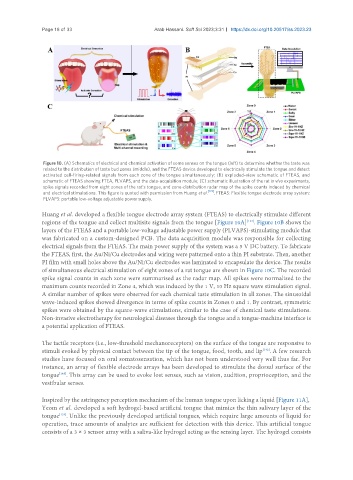
                Figure 10. (A) Schematics of electrical and chemical activation of some senses on the tongue (left) to determine whether the taste was
                related to the distribution of taste bud zones (middle), and the FTEAS device developed to electrically stimulate the tongue and detect
                activated cell-firing-related signals from each zone of the tongue simultaneously; (B) exploded-view schematic of FTEAS, and
                schematic of FTEAS showing FTEA, PLVAPS, and the data-acquisition module; (C) schematic illustration of the rat in vivo experiments,
                spike signals recorded from eight zones of the rat’s tongue, and zone-distribution radar map of the spike counts induced by chemical
                                                                       [123]
                and electrical stimulations. This figure is quoted with permission from Huang et al.  . FTEAS: Flexible tongue electrode array system;
                PLVAPS: portable low-voltage adjustable power supply.
               Huang et al. developed a flexible tongue electrode array system (FTEAS) to electrically stimulate different
               regions of the tongue and collect multisite signals from the tongue [Figure 10A] . Figure 10B shows the
                                                                                    [123]
               layers of the FTEAS and a portable low-voltage adjustable power supply (PLVAPS)-stimulating module that
               was fabricated on a custom-designed PCB. The data acquisition module was responsible for collecting
               electrical signals from the FTEAS. The main power supply of the system was a 5 V DC battery. To fabricate
               the FTEAS, first, the Au/Ni/Cu electrodes and wiring were patterned onto a thin PI substrate. Then, another
               PI film with small holes above the Au/Ni/Cu electrodes was laminated to encapsulate the device. The results
               of simultaneous electrical stimulation of eight zones of a rat tongue are shown in Figure 10C. The recorded
               spike signal counts in each zone were summarised as the radar map. All spikes were normalised to the
               maximum counts recorded in Zone 4, which was induced by the 1 V, 10 Hz square wave stimulation signal.
               A similar number of spikes were observed for each chemical taste stimulation in all zones. The sinusoidal
               wave-induced spikes showed divergence in terms of spike counts in Zones 0 and 1. By contrast, symmetric
               spikes were obtained by the square-wave stimulations, similar to the case of chemical taste stimulations.
               Non-invasive electrotherapy for neurological diseases through the tongue and a tongue-machine interface is
               a potential application of FTEAS.

               The tactile receptors (i.e., low-threshold mechanoreceptors) on the surface of the tongue are responsive to
               stimuli evoked by physical contact between the tip of the tongue, food, tooth, and lip . A few research
                                                                                          [142]
               studies have focused on oral somatosensation, which has not been understood very well thus far. For
               instance, an array of flexible electrode arrays has been developed to stimulate the dorsal surface of the
                     [143]
               tongue . This array can be used to evoke lost senses, such as vision, audition, proprioception, and the
               vestibular senses.

               Inspired by the astringency perception mechanism of the human tongue upon licking a liquid [Figure 11A],
               Yeom et al. developed a soft hydrogel-based artificial tongue that mimics the thin salivary layer of the
               tongue . Unlike the previously developed artificial tongues, which require large amounts of liquid for
                     [124]
               operation, trace amounts of analytes are sufficient for detection with this device. This artificial tongue
               consists of a 3 × 3 sensor array with a saliva-like hydrogel acting as the sensing layer. The hydrogel consists

