


Page 173 - Read Online
P. 173
Arab Hassani. Soft Sci 2023;3:31  https://dx.doi.org/10.20517/ss.2023.23         Page 21 of 33


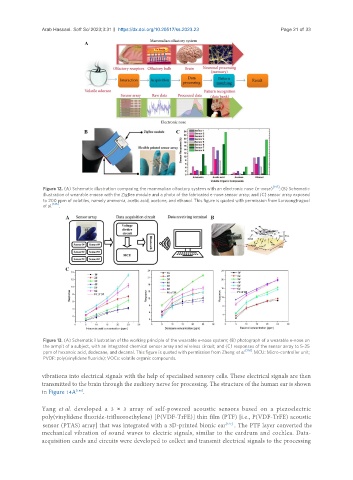
                Figure 12. (A) Schematic illustration comparing the mammalian olfactory system with an electronic nose (e-nose) [145] ; (B) Schematic
                illustration of wearable e-nose with the ZigBee module and a photo of the fabricated e-nose sensor array; and (C) sensor array exposed
                to 200 ppm of volatiles, namely ammonia, acetic acid, acetone, and ethanol. This figure is quoted with permission from Lorwongtragool
                et al. [125] .


                Figure 13. (A) Schematic illustration of the working principle of the wearable e-nose system; (B) photograph of a wearable e-nose on
                the armpit of a subject, with an integrated chemical sensor array and wireless circuit; and (C) responses of the sensor array to 5-25
                                                                                    [126]
                ppm of hexanoic acid, dodecane, and decanal. This figure is quoted with permission from Zheng  et al.  . MCU: Micro-controller unit;
                PVDF: poly(vinylidene fluoride); VOCs: volatile organic compounds.
               vibrations into electrical signals with the help of specialised sensory cells. These electrical signals are then
               transmitted to the brain through the auditory nerve for processing. The structure of the human ear is shown
               in Figure 14A .
                           [146]
               Yang  et al.  developed  a  3  ×  3  array  of  self-powered  acoustic  sensors  based  on  a  piezoelectric
               poly(vinylidene fluoride-trifluoroethylene) [P(VDF-TrFE)] thin film (PTF) [i.e., P(VDF-TrFE) acoustic
               sensor (PTAS) array] that was integrated with a 3D-printed bionic ear      . The PTF layer converted the
                                                                             [127]
               mechanical vibration of sound waves to electric signals, similar to the eardrum and cochlea. Data-
               acquisition cards and circuits were developed to collect and transmit electrical signals to the processing

