


Page 174 - Read Online
P. 174
Page 22 of 33                         Arab Hassani. Soft Sci 2023;3:31  https://dx.doi.org/10.20517/ss.2023.23


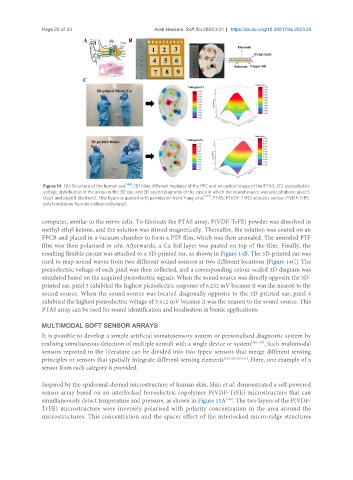
                Figure 14. (A) Structure of the human ear [146] ; (B) Nine different modules of the FPC and an optical image of the PTAS; (C) piezoelectric
                voltage distribution of the array on the 3D ear, and 3D sound diagrams of the cases in which the sound source was placed above pixel 5
                (top) and pixel 8 (bottom). This figure is quoted with permission from Yang et al. [127] . PTAS: P(VDF-TrFE) acoustic sensor; PVDF-TrFE:
                poly(vinylidene fluoride-trifluoroethylene).


               computer, similar to the nerve cells. To fabricate the PTAS array, P(VDF-TrFE) powder was dissolved in
               methyl ethyl ketone, and the solution was stirred magnetically. Thereafter, the solution was coated on an
               FPCB and placed in a vacuum chamber to form a PTF film, which was then annealed. The annealed PTF
               film was then polarised in situ. Afterwards, a Cu foil layer was pasted on top of the film. Finally, the
               resulting flexible circuit was attached to a 3D-printed ear, as shown in Figure 14B. The 3D-printed ear was
               used to map sound waves from two different sound sources at two different locations [Figure 14C]. The
               piezoelectric voltage of each pixel was then collected, and a corresponding colour-scaled 3D diagram was
               simulated based on the acquired piezoelectric signals. When the sound source was directly opposite the 3D-
               printed ear, pixel 5 exhibited the highest piezoelectric response of 6.232 mV because it was the nearest to the
               sound source. When the sound source was located diagonally opposite to the 3D-printed ear, pixel 8
               exhibited the highest piezoelectric voltage of 5.612 mV because it was the nearest to the sound source. This
               PTAS array can be used for sound identification and localisation in bionic applications.


               MULTIMODAL SOFT SENSOR ARRAYS
               It is possible to develop a simple artificial somatosensory system or personalised diagnostic system by
               realising simultaneous detection of multiple stimuli with a single device or system [148-157] . Such multimodal
               sensors reported in the literature can be divided into two types: sensors that merge different sensing
               principles or sensors that spatially integrate different sensing elements [128,129,158-161] . Here, one example of a
               sensor from each category is provided.


               Inspired by the epidermal-dermal microstructure of human skin, Shin et al. demonstrated a self-powered
               sensor array based on an interlocked ferroelectric copolymer P(VDF-TrFE) microstructure that can
                                                                             [128]
               simultaneously detect temperature and pressure, as shown in Figure 15A . The two layers of the P(VDF-
               TrFE) microstructure were inversely polarised with polarity concentration in the area around the
               microstructures. This concentration and the spacer effect of the interlocked micro-ridge structures

