


Page 176 - Read Online
P. 176
Page 24 of 33                         Arab Hassani. Soft Sci 2023;3:31  https://dx.doi.org/10.20517/ss.2023.23


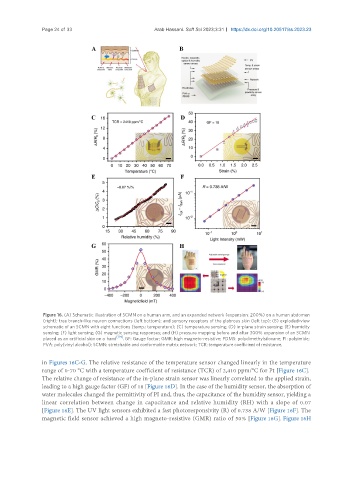
                Figure 16. (A) Schematic illustration of SCMN on a human arm, and an expanded network (expansion: 200%) on a human abdomen
                (right); tree branch-like neuron connections (left bottom); and sensory receptors of the glabrous skin (left top); (B) exploded-view
                schematic of an SCMN with eight functions (temp.: temperature); (C) temperature sensing; (D) in-plane strain sensing; (E) humidity
                sensing; (F) light sensing; (G) magnetic sensing responses; and (H) pressure mapping before and after 300% expansion of an SCMN
                placed as an artificial skin on a  hand [129] . GF: Gauge factor; GMR: high magneto-resistive; PDMS: polydimethylsiloxane; PI: polyimide;
                PVA: poly(vinyl alcohol); SCMN: stretchable and conformable matrix network; TCR: temperature coefficient of resistance.


               in Figures 16C-G. The relative resistance of the temperature sensor changed linearly in the temperature
               range of 0-70 °C with a temperature coefficient of resistance (TCR) of 2,410 ppm/°C for Pt [Figure 16C].
               The relative change of resistance of the in-plane strain sensor was linearly correlated to the applied strain,
               leading to a high gauge factor (GF) of 18 [Figure 16D]. In the case of the humidity sensor, the absorption of
               water molecules changed the permittivity of PI and, thus, the capacitance of the humidity sensor, yielding a
               linear correlation between change in capacitance and relative humidity (RH) with a slope of 0.07
               [Figure 16E]. The UV light sensors exhibited a fast photoresponsivity (R) of 0.738 A/W [Figure 16F]. The
               magnetic field sensor achieved a high magneto-resistive (GMR) ratio of 50% [Figure 16G]. Figure 16H

