


Page 175 - Read Online
P. 175
Arab Hassani. Soft Sci 2023;3:31  https://dx.doi.org/10.20517/ss.2023.23         Page 23 of 33


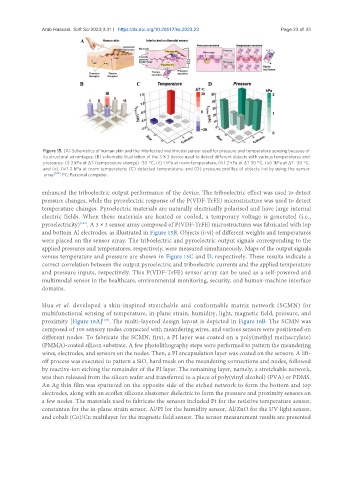
                Figure 15. (A) Schematics of human skin and the interlocked multimodal sensor used for pressure and temperature sensing because of
                its structural advantages; (B) schematic illustration of the 3 × 3 device used to detect different objects with various temperatures and
                pressures: (i) 2 kPa at ΔT (temperature change) -30 °C, (ii) 1 kPa at room temperature, (iii) 2 kPa at ΔT 30 °C, (iv) 1kPa at ΔT -30 °C,
                and (v), (vi) 2 kPa at room temperature; (C) detected temperature; and (D) pressure profiles of objects i-vi by using the sensor
                array [128] . PC: Personal computer.


               enhanced the triboelectric output performance of the device. The triboelectric effect was used to detect
               pressure changes, while the pyroelectric response of the P(VDF-TrFE) microstructure was used to detect
               temperature changes. Pyroelectric materials are naturally electrically polarised and have large internal
               electric fields. When these materials are heated or cooled, a temporary voltage is generated (i.e.,
               pyroelectricity) . A 3 × 3 sensor array composed of P(VDF-TrFE) microstructures was fabricated with top
                            [162]
               and bottom Al electrodes, as illustrated in Figure 15B. Objects (i-vi) of different weights and temperatures
               were placed on the sensor array. The triboelectric and pyroelectric output signals corresponding to the
               applied pressures and temperatures, respectively, were measured simultaneously. Maps of the output signals
               versus temperature and pressure are shown in Figure 15C and D, respectively. These results indicate a
               correct correlation between the output pyroelectric and triboelectric currents and the applied temperature
               and pressure inputs, respectively. This P(VDF-TrFE) sensor array can be used as a self-powered and
               multimodal sensor in the healthcare, environmental monitoring, security, and human-machine interface
               domains.

               Hua et  al. developed a skin-inspired stretchable and conformable matrix network (SCMN) for
               multifunctional sensing of temperature, in-plane strain, humidity, light, magnetic field, pressure, and
               proximity [Figure 16A] . The multi-layered design layout is depicted in Figure 16B. The SCMN was
                                   [129]
               composed of 100 sensory nodes connected with meandering wires, and various sensors were positioned on
               different nodes. To fabricate the SCMN, first, a PI layer was coated on a poly(methyl methacrylate)
               (PMMA)-coated silicon substrate. A few photolithography steps were performed to pattern the meandering
               wires, electrodes, and sensors on the nodes. Then, a PI encapsulation layer was coated on the sensors. A lift-
               off process was executed to pattern a SiO  hard mask on the meandering connections and nodes, followed
                                                  2
               by reactive-ion etching the remainder of the PI layer. The remaining layer, namely, a stretchable network,
               was then released from the silicon wafer and transferred to a piece of poly(vinyl alcohol) (PVA) or PDMS.
               An Ag thin film was sputtered on the opposite side of the etched network to form the bottom and top
               electrodes, along with an ecoflex silicone elastomer dielectric to form the pressure and proximity sensors on
               a few nodes. The materials used to fabricate the sensors included Pt for the resistive temperature sensor,
               constantan for the in-plane strain sensor, Al/PI for the humidity sensor, Al/ZnO for the UV light sensor,
               and cobalt (Co)/Cu multilayer for the magnetic field sensor. The sensor measurement results are presented

