


Page 166 - Read Online
P. 166
Page 14 of 33                         Arab Hassani. Soft Sci 2023;3:31  https://dx.doi.org/10.20517/ss.2023.23


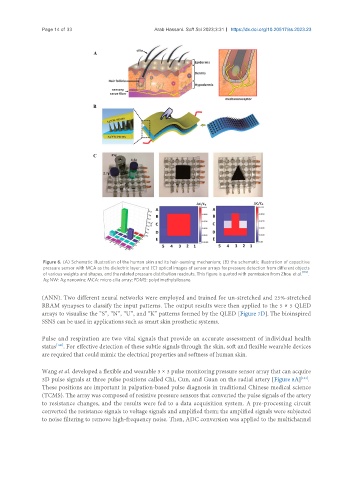
                Figure 6. (A) Schematic illustration of the human skin and its hair-sensing mechanism; (B) the schematic illustration of capacitive
                pressure sensor with MCA as the dielectric layer; and (C) optical images of sensor arrays for pressure detection from different objects
                of various weights and shapes, and the related pressure distribution readouts. This figure is quoted with permission from Zhou et al. [119] .
                Ag NW: Ag nanowire; MCA: micro cilia array; PDMS: polydimethylsiloxane.


               (ANN). Two different neural networks were employed and trained for un-stretched and 25%-stretched
               RRAM synapses to classify the input patterns. The output results were then applied to the 5 × 5 QLED
               arrays to visualise the “S”, “N”, “U”, and “K” patterns formed by the QLED [Figure 7D]. The bioinspired
               SSNS can be used in applications such as smart skin prosthetic systems.

               Pulse and respiration are two vital signals that provide an accurate assessment of individual health
                    [140]
               status . For effective detection of these subtle signals through the skin, soft and flexible wearable devices
               are required that could mimic the electrical properties and softness of human skin.

               Wang et al. developed a flexible and wearable 3 × 3 pulse monitoring pressure sensor array that can acquire
                                                                                                      [121]
               3D pulse signals at three pulse positions called Chi, Cun, and Guan on the radial artery [Figure 8A] .
               These positions are important in palpation-based pulse diagnosis in traditional Chinese medical science
               (TCMS). The array was composed of resistive pressure sensors that converted the pulse signals of the artery
               to resistance changes, and the results were fed to a data acquisition system. A pre-processing circuit
               converted the resistance signals to voltage signals and amplified them; the amplified signals were subjected
               to noise filtering to remove high-frequency noise. Then, ADC conversion was applied to the multichannel

