


Page 163 - Read Online
P. 163
Arab Hassani. Soft Sci 2023;3:31  https://dx.doi.org/10.20517/ss.2023.23         Page 11 of 33

               beings. This additional sensory mechanism could help blind or visually impaired people, who cannot rely
               on visual sensations, to perceive space.

               Virtual reality (VR) usually involves providing audio and visual feedback to generate a virtual world in
                                                     [133]
               which users can interact with virtual objects . In augmented reality (AR), the virtual and real worlds are
               combined using advanced electronics and data processing systems . VR/AR devices are not directly
                                                                          [134]
               inspired by bioreceptors, but they draw upon the human perceptual and sensory system to create immersive
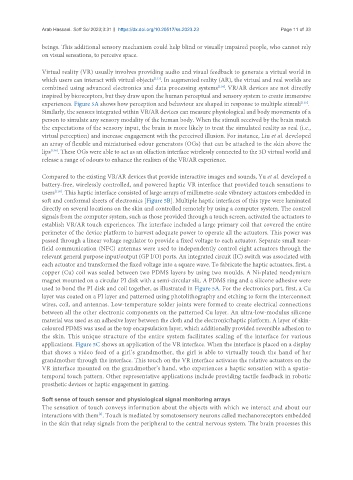
               experiences. Figure 5A shows how perception and behaviour are shaped in response to multiple stimuli .
                                                                                                      [135]
               Similarly, the sensors integrated within VR/AR devices can measure physiological and body movements of a
               person to simulate any sensory modality of the human body. When the stimuli received by the brain match
               the expectations of the sensory input, the brain is more likely to treat the simulated reality as real (i.e.,
               virtual perception) and increase engagement with the perceived illusion. For instance, Liu et al. developed
               an array of flexible and miniaturised odour generators (OGs) that can be attached to the skin above the
               lips . These OGs were able to act as an olfaction interface wirelessly connected to the 3D virtual world and
                  [136]
               release a range of odours to enhance the realism of the VR/AR experience.

               Compared to the existing VR/AR devices that provide interactive images and sounds, Yu et al. developed a
               battery-free, wirelessly controlled, and powered haptic VR interface that provided touch sensations to
                   [118]
               users . This haptic interface consisted of large arrays of millimetre-scale vibratory actuators embedded in
               soft and conformal sheets of electronics [Figure 5B]. Multiple haptic interfaces of this type were laminated
               directly on several locations on the skin and controlled remotely by using a computer system. The control
               signals from the computer system, such as those provided through a touch screen, activated the actuators to
               establish VR/AR touch experiences. The interface included a large primary coil that covered the entire
               perimeter of the device platform to harvest adequate power to operate all the actuators. This power was
               passed through a linear voltage regulator to provide a fixed voltage to each actuator. Separate small near-
               field communication (NFC) antennas were used to independently control eight actuators through the
               relevant general purpose input/output (GP I/O) ports. An integrated circuit (IC) switch was associated with
               each actuator and transformed the fixed voltage into a square wave. To fabricate the haptic actuators, first, a
               copper (Cu) coil was sealed between two PDMS layers by using two moulds. A Ni-plated neodymium
               magnet mounted on a circular PI disk with a semi-circular slit. A PDMS ring and a silicone adhesive were
               used to bond the PI disk and coil together, as illustrated in Figure 5A. For the electronics part, first, a Cu
               layer was coated on a PI layer and patterned using photolithography and etching to form the interconnect
               wires, coil, and antennas. Low-temperature solder joints were formed to create electrical connections
               between all the other electronic components on the patterned Cu layer. An ultra-low-modulus silicone
               material was used as an adhesive layer between the cloth and the electronic/haptic platform. A layer of skin-
               coloured PDMS was used as the top encapsulation layer, which additionally provided reversible adhesion to
               the skin. This unique structure of the entire system facilitates scaling of the interface for various
               applications. Figure 5C shows an application of the VR interface. When the interface is placed on a display
               that shows a video feed of a girl’s grandmother, the girl is able to virtually touch the hand of her
               grandmother through the interface. This touch on the VR interface activates the relative actuators on the
               VR interface mounted on the grandmother’s hand, who experiences a haptic sensation with a spatio-
               temporal touch pattern. Other representative applications include providing tactile feedback in robotic
               prosthetic devices or haptic engagement in gaming.


               Soft sense of touch sensor and physiological signal monitoring arrays
               The sensation of touch conveys information about the objects with which we interact and about our
               interactions with them . Touch is mediated by somatosensory neurons called mechanoreceptors embedded
                                  [6]
               in the skin that relay signals from the peripheral to the central nervous system. The brain processes this

