


Page 162 - Read Online
P. 162
Page 10 of 33                         Arab Hassani. Soft Sci 2023;3:31  https://dx.doi.org/10.20517/ss.2023.23


                and stimulation; (E) optical camera image of the CurvIS array and UNE stack connected through the soft FPCB; and (F) university logo
                image captured by the CurvIS array [116] . FPCB: Flexible printed circuit board; UNE: ultra-thin neural-interfacing electrodes.


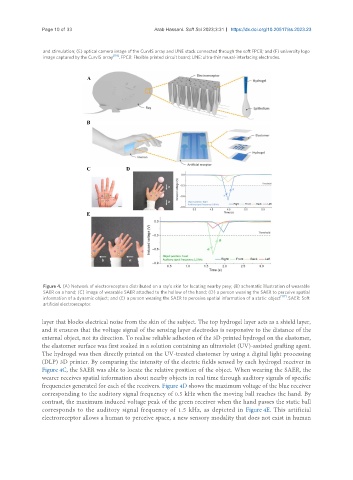
                Figure 4. (A) Network of electroreceptors distributed on a ray’s skin for locating nearby prey; (B) schematic illustration of wearable
                SAER on a hand; (C) image of wearable SAER attached to the hollow of the hand; (D) a person wearing the SAER to perceive spatial
                                                                                                [117]
                information of a dynamic object; and (E) a person wearing the SAER to perceive spatial information of a static  object  . SAER: Soft
                artificial electroreceptor.

               layer that blocks electrical noise from the skin of the subject. The top hydrogel layer acts as a shield layer,
               and it ensures that the voltage signal of the sensing layer electrodes is responsive to the distance of the
               external object, not its direction. To realise reliable adhesion of the 3D-printed hydrogel on the elastomer,
               the elastomer surface was first soaked in a solution containing an ultraviolet (UV)-assisted grafting agent.
               The hydrogel was then directly printed on the UV-treated elastomer by using a digital light processing
               (DLP) 3D printer. By comparing the intensity of the electric fields sensed by each hydrogel receiver in
               Figure 4C, the SAER was able to locate the relative position of the object. When wearing the SAER, the
               wearer receives spatial information about nearby objects in real time through auditory signals of specific
               frequencies generated for each of the receivers. Figure 4D shows the maximum voltage of the blue receiver
               corresponding to the auditory signal frequency of 0.5 kHz when the moving ball reaches the hand. By
               contrast, the maximum induced voltage peak of the green receiver when the hand passes the static ball
               corresponds to the auditory signal frequency of 1.5 kHz, as depicted in Figure 4E. This artificial
               electroreceptor allows a human to perceive space, a new sensory modality that does not exist in human

