


Page 141 - Read Online
P. 141
Page 16 of 27                            Tian et al. Soft Sci 2023;3:30  https://dx.doi.org/10.20517/ss.2023.21


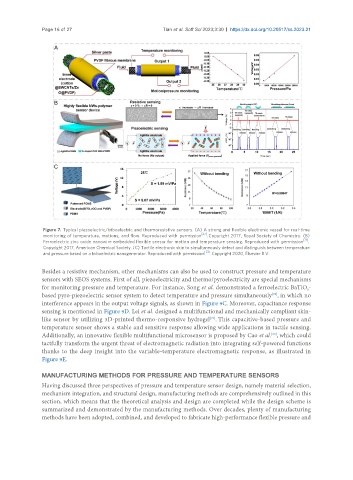
                Figure 7. Typical piezoelectric/triboelectric and thermoresistive sensors. (A) A strong and flexible electronic vessel for real-time
                                                                     [27]
                monitoring of temperature, motions, and flow. Reproduced with  permission  . Copyright 2017, Royal Society of Chemistry. (B)
                                                                                                       [71]
                Ferroelectric zinc oxide nanowire embedded flexible sensor for motion and temperature sensing. Reproduced with  permission  .
                Copyright 2017, American Chemical Society. (C) Tactile electronic skin to simultaneously detect and distinguish between temperature
                                                                      [23]
                and pressure based on a triboelectric nanogenerator. Reproduced with permission  . Copyright 2020, Elsevier B.V.
               Besides a resistive mechanism, other mechanisms can also be used to construct pressure and temperature
               sensors with SEOS systems. First of all, piezoelectricity and thermo/pyroelectricity are special mechanisms
               for monitoring pressure and temperature. For instance, Song et al. demonstrated a ferroelectric BaTiO -
                                                                                                         3
                                                                                             [78]
               based pyro-piezoelectric sensor system to detect temperature and pressure simultaneously , in which no
               interference appears in the output voltage signals, as shown in Figure 9C. Moreover, capacitance response
               sensing is mentioned in Figure 9D. Lei et al. designed a multifunctional and mechanically compliant skin-
                                                                        [79]
               like sensor by utilizing 3D-printed thermo-responsive hydrogel . This capacitive-based pressure and
               temperature sensor shows a stable and sensitive response allowing wide applications in tactile sensing.
               Additionally, an innovative flexible multifunctional microsensor is proposed by Cao et al. , which could
                                                                                            [80]
               tactfully transform the urgent threat of electromagnetic radiation into integrating self-powered functions
               thanks to the deep insight into the variable-temperature electromagnetic response, as illustrated in
               Figure 9E.

               MANUFACTURING METHODS FOR PRESSURE AND TEMPERATURE SENSORS
               Having discussed three perspectives of pressure and temperature sensor design, namely material selection,
               mechanism integration, and structural design, manufacturing methods are comprehensively outlined in this
               section, which means that the theoretical analysis and design are completed while the design scheme is
               summarized and demonstrated by the manufacturing methods. Over decades, plenty of manufacturing
               methods have been adopted, combined, and developed to fabricate high-performance flexible pressure and

