


Page 140 - Read Online
P. 140
Tian et al. Soft Sci 2023;3:30  https://dx.doi.org/10.20517/ss.2023.21          Page 15 of 27


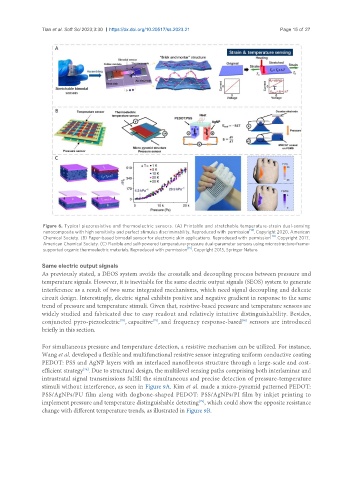
                Figure 6. Typical piezoresistive and thermoelectric sensors. (A) Printable and stretchable temperature-strain dual-sensing
                nanocomposite with high sensitivity and perfect stimulus discriminability. Reproduced with permission [13] . Copyright 2020, American
                Chemical Society. (B) Paper-based bimodal sensor for electronic skin applications. Reproduced with  permission [14] . Copyright 2017,
                American Chemical Society. (C) Flexible and self-powered temperature-pressure dual-parameter sensors using microstructure-frame-
                supported organic thermoelectric materials. Reproduced with permission [15] . Copyright 2015, Springer Nature.


               Same electric output signals
               As previously stated, a DEOS system avoids the crosstalk and decoupling process between pressure and
               temperature signals. However, it is inevitable for the same electric output signals (SEOS) system to generate
               interference as a result of two same integrated mechanisms, which need signal decoupling and delicate
               circuit design. Interestingly, electric signal exhibits positive and negative gradient in response to the same
               trend of pressure and temperature stimuli. Given that, resistive-based pressure and temperature sensors are
               widely studied and fabricated due to easy readout and relatively intuitive distinguishability. Besides,
                                                     [79]
                                         [78]
               conjuncted pyro-piezoelectric , capacitive , and frequency response-based  sensors are introduced
                                                                                   [80]
               briefly in this section.
               For simultaneous pressure and temperature detection, a resistive mechanism can be utilized. For instance,
               Wang et al. developed a flexible and multifunctional resistive sensor integrating uniform conductive coating
               PEDOT: PSS and AgNP layers with an interlaced nanofibrous structure through a large-scale and cost-
               efficient strategy . Due to structural design, the multilevel sensing paths comprising both interlaminar and
                             [74]
               intrastratal signal transmissions fulfill the simultaneous and precise detection of pressure-temperature
               stimuli without interference, as seen in Figure 9A. Kim et al. made a micro-pyramid patterned PEDOT:
               PSS/AgNPs/PU film along with dogbone-shaped PEDOT: PSS/AgNPs/PI film by inkjet printing to
                                                                    [75]
               implement pressure and temperature distinguishable detecting , which could show the opposite resistance
               change with different temperature trends, as illustrated in Figure 9B.

