


Page 142 - Read Online
P. 142
Tian et al. Soft Sci 2023;3:30  https://dx.doi.org/10.20517/ss.2023.21          Page 17 of 27


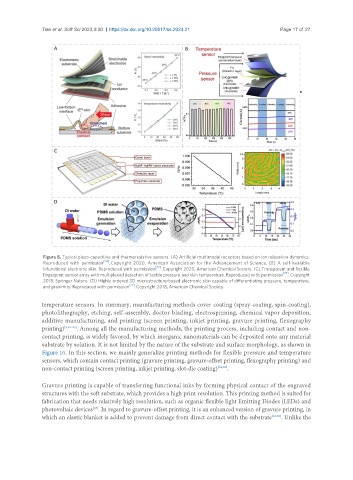
                Figure 8. Typical piezo-capacitive and thermoresistive sensors. (A) Artificial multimodal receptors based on ion relaxation dynamics.
                Reproduced with  permission [24] . Copyright 2020, American Association for the Advancement of Science. (B) A self-healable
                bifunctional electronic skin. Reproduced with permission [72] . Copyright 2020, American Chemical Society. (C) Transparent and flexible
                fingerprint sensor array with multiplexed detection of tactile pressure and skin temperature. Reproduced with permission [73] . Copyright
                2018, Springer Nature. (D) Highly ordered 3D microstructure-based electronic skin capable of differentiating pressure, temperature,
                                             [77]
                and proximity. Reproduced with permission  . Copyright 2018, American Chemical Society.
               temperature sensors. In summary, manufacturing methods cover coating (spray-coating, spin-coating),
               photolithography, etching, self-assembly, doctor-blading, electrospinning, chemical vapor deposition,
               additive manufacturing, and printing (screen printing, inkjet printing, gravure printing, flexography
               printing) [3,81-83] . Among all the manufacturing methods, the printing process, including contact and non-
               contact printing, is widely favored, by which inorganic nanomaterials can be deposited onto any material
               substrate by solution. It is not limited by the nature of the substrate and surface morphology, as shown in
               Figure 10. In this section, we mainly generalize printing methods for flexible pressure and temperature
               sensors, which contain contact printing (gravure printing, gravure-offset printing, flexography printing) and
               non-contact printing (screen printing, inkjet printing, slot-die coating) [82,83] .

               Gravure printing is capable of transferring functional inks by forming physical contact of the engraved
               structures with the soft substrate, which provides a high print resolution. This printing method is suited for
               fabrication that needs relatively high resolution, such as organic flexible light Emitting Diodes (LEDs) and
               photovoltaic devices . In regard to gravure-offset printing, it is an enhanced version of gravure printing, in
                                [84]
               which an elastic blanket is added to prevent damage from direct contact with the substrate [83,89] . Unlike the

