


Page 143 - Read Online
P. 143
Page 18 of 27                            Tian et al. Soft Sci 2023;3:30  https://dx.doi.org/10.20517/ss.2023.21


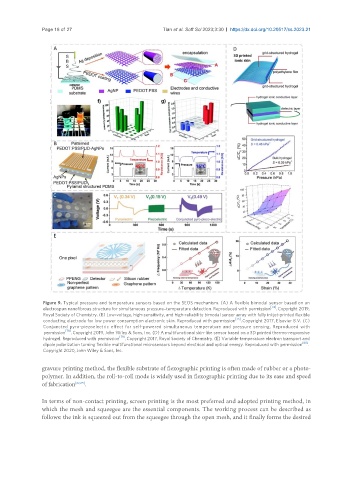
                Figure 9. Typical pressure and temperature sensors based on the SEOS mechanism. (A) A flexible bimodal sensor based on an
                electrospun nanofibrous structure for simultaneous pressure–temperature detection. Reproduced with permission [74] . Copyright 2019,
                Royal Society of Chemistry. (B) Low-voltage, high-sensitivity, and high-reliability bimodal sensor array with fully inkjet-printed flexible
                                                                                [75]
                conducting electrode for low power consumption electronic skin. Reproduced with  permission  . Copyright 2017, Elsevier B.V. (C)
                Conjuncted  pyro-piezoelectric  effect  for  self-powered  simultaneous  temperature  and  pressure  sensing.  Reproduced  with
                       [78]
                permission  . Copyright 2019, John Wiley & Sons, Inc. (D) A multifunctional skin-like sensor based on a 3D printed thermo-responsive
                                         [79]
                hydrogel. Reproduced with permission  . Copyright 2017, Royal Society of Chemistry. (E) Variable-temperature electron transport and
                                                                                                       [80]
                dipole polarization turning flexible multifunctional microsensors beyond electrical and optical energy. Reproduced with permission  .
                Copyright 2020, John Wiley & Sons, Inc.
               gravure printing method, the flexible substrate of flexographic printing is often made of rubber or a photo-
               polymer. In addition, the roll-to-roll mode is widely used in flexographic printing due to its ease and speed
               of fabrication [82,85] .


               In terms of non-contact printing, screen printing is the most preferred and adopted printing method, in
               which the mesh and squeegee are the essential components. The working process can be described as
               follows: the ink is squeezed out from the squeegee through the open mesh, and it finally forms the desired

