


Page 146 - Read Online
P. 146
Tian et al. Soft Sci 2023;3:30  https://dx.doi.org/10.20517/ss.2023.21          Page 21 of 27


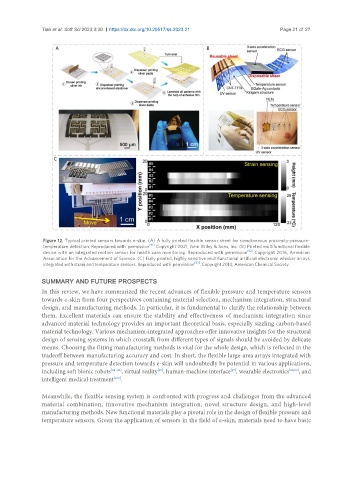
                Figure 12. Typical printed sensors towards e-skin. (A) A fully printed flexible sensor sheet for simultaneous proximity-pressure-
                temperature detection. Reproduced with  permission [91] . Copyright 2021, John Wiley & Sons, Inc. (B) Printed multifunctional flexible
                device with an integrated motion sensor for health care monitoring. Reproduced with  permission [92] . Copyright 2016, American
                Association for the Advancement of Science. (C) Fully printed, highly sensitive multifunctional artificial electronic whisker arrays
                integrated with strain and temperature sensors. Reproduced with permission [93] . Copyright 2014, American Chemical Society.


               SUMMARY AND FUTURE PROSPECTS
               In this review, we have summarized the recent advances of flexible pressure and temperature sensors
               towards e-skin from four perspectives containing material selection, mechanism integration, structural
               design, and manufacturing methods. In particular, it is fundamental to clarify the relationship between
               them. Excellent materials can ensure the stability and effectiveness of mechanism integration since
               advanced material technology provides an important theoretical basis, especially sizzling carbon-based
               material technology. Various mechanism-integrated approaches offer innovative insights for the structural
               design of sensing systems in which crosstalk from different types of signals should be avoided by delicate
               means. Choosing the fitting manufacturing methods is vital for the whole design, which is reflected in the
               tradeoff between manufacturing accuracy and cost. In short, the flexible large-area arrays integrated with
               pressure and temperature detection towards e-skin will undoubtedly be potential in various applications,
                                                      [97]
                                                                               [97]
               including soft bionic robots [94 -96] , virtual reality , human-machine interface , wearable electronics [98,99] , and
                                       [100]
               intelligent medical treatment .
               Meanwhile, the flexible sensing system is confronted with progress and challenges from the advanced
               material combination, innovative mechanism integration, novel structure design, and high-level
               manufacturing methods. New functional materials play a pivotal role in the design of flexible pressure and
               temperature sensors. Given the application of sensors in the field of e-skin, materials need to have basic

