


Page 144 - Read Online
P. 144
Tian et al. Soft Sci 2023;3:30  https://dx.doi.org/10.20517/ss.2023.21          Page 19 of 27


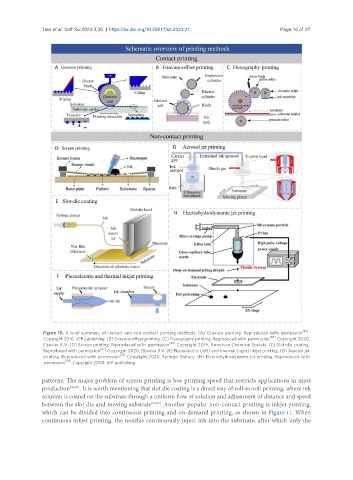
                Figure 10. A brief summary of contact and non-contact printing methods. (A) Gravure printing. Reproduced with  permission [84] .
                Copyright 2016, IOP publishing. (B) Gravure-offset printing. (C) Flexography printing. Reproduced with permission [85] . Copyright 2020,
                Elsevier B.V. (D) Screen printing. Reproduced with  permission [86] . Copyright 2019, American Chemical Society. (E) Slot-die coating.
                Reproduced with permission [87] . Copyright 2020, Elsevier B.V. (F) Piezoelectric (left) and thermal (right) inkjet printing. (G) Aerosol jet
                printing. Reproduced with  permission [29] . Copyright 2020, Springer Nature. (H) Electrohydrodynamic jet printing. Reproduced with
                permission [88] . Copyright 2008, AIP publishing.

               patterns. The major problem of screen printing is low printing speed that restricts applications in mass
               production [82,86] . It is worth mentioning that slot die coating is a direct way of roll-to-roll printing, where ink
               solution is coated on the substrate through a uniform flow of solution and adjustment of distance and speed
               between the slot die and moving substrate [83,87] . Another popular non-contact printing is inkjet printing,
               which can be divided into continuous printing and on-demand printing, as shown in Figure 11. When
               continuous inkjet printing, the nozzles continuously inject ink into the substrate, after which only the

