


Page 145 - Read Online
P. 145
Page 20 of 27                            Tian et al. Soft Sci 2023;3:30  https://dx.doi.org/10.20517/ss.2023.21


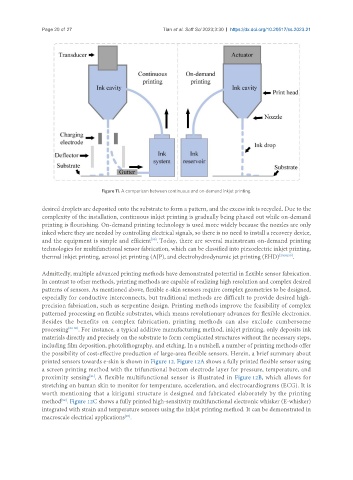
                                   Figure 11. A comparison between continuous and on-demand inkjet printing.

               desired droplets are deposited onto the substrate to form a pattern, and the excess ink is recycled. Due to the
               complexity of the installation, continuous inkjet printing is gradually being phased out while on-demand
               printing is flourishing. On-demand printing technology is used more widely because the nozzles are only
               inked where they are needed by controlling electrical signals, so there is no need to install a recovery device,
                                                    [90]
               and the equipment is simple and efficient . Today, there are several mainstream on-demand printing
               technologies for multifunctional sensor fabrication, which can be classified into piezoelectric inkjet printing,
               thermal inkjet printing, aerosol jet printing (AJP), and electrohydrodynamic jet printing (EHD) [29,88,90] .


               Admittedly, multiple advanced printing methods have demonstrated potential in flexible sensor fabrication.
               In contrast to other methods, printing methods are capable of realizing high resolution and complex desired
               patterns of sensors. As mentioned above, flexible e-skin sensors require complex geometries to be designed,
               especially for conductive interconnects, but traditional methods are difficult to provide desired high-
               precision fabrication, such as serpentine design. Printing methods improve the feasibility of complex
               patterned processing on flexible substrates, which means revolutionary advances for flexible electronics.
               Besides  the  benefits  on  complex  fabrication,  printing  methods  can  also  exclude  cumbersome
               processing [83-90] . For instance, a typical additive manufacturing method, inkjet printing, only deposits ink
               materials directly and precisely on the substrate to form complicated structures without the necessary steps,
               including film deposition, photolithography, and etching. In a nutshell, a number of printing methods offer
               the possibility of cost-effective production of large-area flexible sensors. Herein, a brief summary about
               printed sensors towards e-skin is shown in Figure 12. Figure 12A shows a fully printed flexible sensor using
               a screen printing method with the trifunctional bottom electrode layer for pressure, temperature, and
                               [91]
               proximity sensing . A flexible multifunctional sensor is illustrated in Figure 12B, which allows for
               stretching on human skin to monitor for temperature, acceleration, and electrocardiograms (ECG). It is
               worth mentioning that a kirigami structure is designed and fabricated elaborately by the printing
                      [92]
               method . Figure 12C shows a fully printed high-sensitivity multifunctional electronic whisker (E-whisker)
               integrated with strain and temperature sensors using the inkjet printing method. It can be demonstrated in
               macroscale electrical applications .
                                           [93]

