


Page 136 - Read Online
P. 136
Tian et al. Soft Sci 2023;3:30  https://dx.doi.org/10.20517/ss.2023.21          Page 11 of 27

               Moreover, some materials, such as semiconductors and CPs, can generate output AC voltage owing to the
               internal electron motion with external temperature stimuli, which is not only a symbol of temperature
                                                               [62]
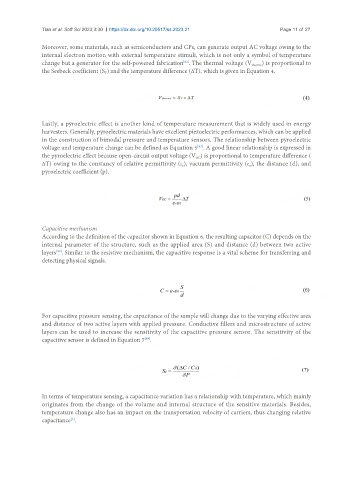
               change but a generator for the self-powered fabrication . The thermal voltage (V thermo ) is proportional to
               the Seebeck coefficient (S ) and the temperature difference (ΔT), which is given in Equation 4.
                                    T


               Lastly, a pyroelectric effect is another kind of temperature measurement that is widely used in energy
               harvesters. Generally, pyroelectric materials have excellent piezoelectric performances, which can be applied
               in the construction of bimodal pressure and temperature sensors. The relationship between pyroelectric
                                                                    [63]
               voltage and temperature change can be defined as Equation 5 . A good linear relationship is expressed in
               the pyroelectric effect because open-circuit output voltage (V ) is proportional to temperature difference (
                                                                   OC
               ΔT) owing to the constancy of relative permittivity (ε ), vacuum permittivity (ε ), the distance (d), and
                                                                                     0
                                                               r
               pyroelectric coefficient (p).


               Capacitive mechanism
               According to the definition of the capacitor shown in Equation 6, the resulting capacitor (C) depends on the
               internal parameter of the structure, such as the applied area (S) and distance (d) between two active
                    [58]
               layers . Similar to the resistive mechanism, the capacitive response is a vital scheme for transferring and
               detecting physical signals.


               For capacitive pressure sensing, the capacitance of the sample will change due to the varying effective area
               and distance of two active layers with applied pressure. Conductive fillers and microstructure of active
               layers can be used to increase the sensitivity of the capacitive pressure sensor. The sensitivity of the
               capacitive sensor is defined in Equation 7 .
                                                  [69]


               In terms of temperature sensing, a capacitance variation has a relationship with temperature, which mainly
               originates from the change of the volume and internal structure of the sensitive materials. Besides,
               temperature change also has an impact on the transportation velocity of carriers, thus changing relative
               capacitance .
                         [3]

