


Page 134 - Read Online
P. 134
Tian et al. Soft Sci 2023;3:30  https://dx.doi.org/10.20517/ss.2023.21           Page 9 of 27


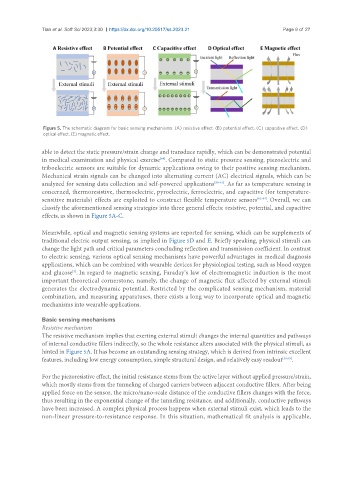
                Figure 5. The schematic diagram for basic sensing mechanisms: (A) resistive effect. (B) potential effect. (C) capacitive effect. (D)
                optical effect. (E) magnetic effect.

               able to detect the static pressure/strain change and transduce rapidly, which can be demonstrated potential
               in medical examination and physical exercise . Compared to static pressure sensing, piezoelectric and
                                                       [69]
               triboelectric sensors are suitable for dynamic applications owing to their positive sensing mechanism.
               Mechanical strain signals can be changed into alternating current (AC) electrical signals, which can be
               analyzed for sensing data collection and self-powered applications [58-61] . As far as temperature sensing is
               concerned, thermoresistive, thermoelectric, pyroelectric, ferroelectric, and capacitive (for temperature-
               sensitive materials) effects are exploited to construct flexible temperature sensors [62-64] . Overall, we can
               classify the aforementioned sensing strategies into three general effects: resistive, potential, and capacitive
               effects, as shown in Figure 5A-C.

               Meanwhile, optical and magnetic sensing systems are reported for sensing, which can be supplements of
               traditional electric output sensing, as implied in Figure 5D and E. Briefly speaking, physical stimuli can
               change the light path and critical parameters concluding reflection and transmission coefficient. In contrast
               to electric sensing, various optical sensing mechanisms have powerful advantages in medical diagnosis
               applications, which can be combined with wearable devices for physiological testing, such as blood oxygen
               and glucose . In regard to magnetic sensing, Faraday’s law of electromagnetic induction is the most
                         [3]
               important theoretical cornerstone, namely, the change of magnetic flux affected by external stimuli
               generates the electrodynamic potential. Restricted by the complicated sensing mechanism, material
               combination, and measuring apparatuses, there exists a long way to incorporate optical and magnetic
               mechanisms into wearable applications.


               Basic sensing mechanisms
               Resistive mechanism
               The resistive mechanism implies that exerting external stimuli changes the internal quantities and pathways
               of internal conductive fillers indirectly, so the whole resistance alters associated with the physical stimuli, as
               hinted in Figure 5A. It has become an outstanding sensing strategy, which is derived from intrinsic excellent
               features, including low energy consumption, simple structural design, and relatively easy readout [59,69] .

               For the piezoresistive effect, the initial resistance stems from the active layer without applied pressure/strain,
               which mostly stems from the tunneling of charged carriers between adjacent conductive fillers. After being
               applied force on the sensor, the micro/nano-scale distance of the conductive fillers changes with the force,
               thus resulting in the exponential change of the tunneling resistance, and additionally, conductive pathways
               have been increased. A complex physical process happens when external stimuli exist, which leads to the
               non-linear pressure-to-resistance response. In this situation, mathematical fit analysis is applicable,

