


Page 129 - Read Online
P. 129
Page 4 of 27                             Tian et al. Soft Sci 2023;3:30  https://dx.doi.org/10.20517/ss.2023.21


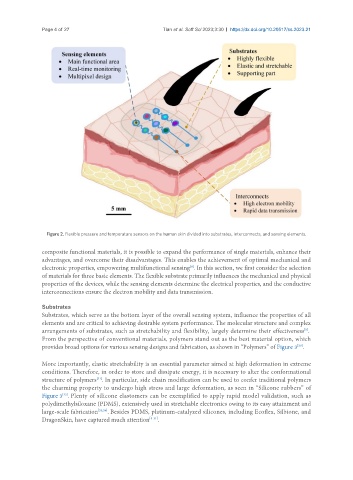
                 Figure 2. Flexible pressure and temperature sensors on the human skin divided into substrates, interconnects, and sensing elements.

               composite functional materials, it is possible to expand the performance of single materials, enhance their
               advantages, and overcome their disadvantages. This enables the achievement of optimal mechanical and
               electronic properties, empowering multifunctional sensing . In this section, we first consider the selection
                                                                 [8]
               of materials for three basic elements. The flexible substrate primarily influences the mechanical and physical
               properties of the devices, while the sensing elements determine the electrical properties, and the conductive
               interconnections ensure the electron mobility and data transmission.

               Substrates
               Substrates, which serve as the bottom layer of the overall sensing system, influence the properties of all
               elements and are critical to achieving desirable system performance. The molecular structure and complex
                                                                                                        [8]
               arrangements of substrates, such as stretchability and flexibility, largely determine their effectiveness .
               From the perspective of conventional materials, polymers stand out as the best material option, which
               provides broad options for various sensing designs and fabrication, as shown in “Polymers” of Figure 3 .
                                                                                                     [30]

               More importantly, elastic stretchability is an essential parameter aimed at high deformation in extreme
               conditions. Therefore, in order to store and dissipate energy, it is necessary to alter the conformational
                                  [31]
               structure of polymers . In particular, side chain modification can be used to confer traditional polymers
               the charming property to undergo high stress and large deformation, as seen in “Silicone rubbers” of
               Figure 3 . Plenty of silicone elastomers can be exemplified to apply rapid model validation, such as
                      [32]
               polydimethylsiloxane (PDMS), extensively used in stretchable electronics owing to its easy attainment and
               large-scale fabrication [33,34] . Besides PDMS, platinum-catalyzed silicones, including Ecoflex, Silbione, and
               DragonSkin, have captured much attention [8-31] .

