


Page 130 - Read Online
P. 130
Tian et al. Soft Sci 2023;3:30  https://dx.doi.org/10.20517/ss.2023.21           Page 5 of 27


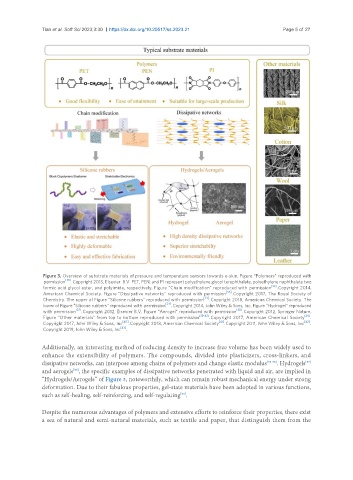
                Figure 3. Overview of substrate materials of pressure and temperature sensors towards e-skin. Figure “Polymers” reproduced with
                permission [30] . Copyright 2015, Elsevier. B.V. PET, PEN, and PI represent polyethylene glycol terephthalate, polyethylene naphthalate two
                formic acid glycol ester, and polyimide, respectively. Figure “Chain modification” reproduced with  permission [32] . Copyright 2014,
                American Chemical Society. Figure “Dissipative networks” reproduced with  permission [36] . Copyright 2017, The Royal Society of
                Chemistry. The upper of Figure “Silicone rubbers” reproduced with  permission [33] . Copyright 2018, American Chemical Society. The
                lower of Figure “Silicone rubbers” reproduced with permission [34] . Copyright 2014, John Wiley & Sons, Inc. Figure “Hydrogel” reproduced
                with  permission [37] . Copyright 2012, Elsevier B.V. Figure “Aerogel” reproduced with  permission [38] . Copyright 2012, Springer Nature.
                Figure “Other materials” from top to bottom reproduced with  permission [39-43] . Copyright 2017, American Chemical  Society [39] .
                Copyright 2017, John Wiley & Sons, Inc [40] . Copyright 2018, American Chemical Society [41] . Copyright 2011, John Wiley & Sons, Inc [42] .
                Copyright 2019, John Wiley & Sons, Inc [43] .

               Additionally, an interesting method of reducing density to increase free volume has been widely used to
               enhance the extensibility of polymers. The compounds, divided into plasticizers, cross-linkers, and
                                                                                                        [37]
               dissipative networks, can interpose among chains of polymers and change elastic modulus [35-36] . Hydrogels
               and aerogels , the specific examples of dissipative networks penetrated with liquid and air, are implied in
                          [38]
               “Hydrogels/Aerogels” of Figure 3, noteworthily, which can remain robust mechanical energy under strong
               deformation. Due to their fabulous properties, gel-state materials have been adopted in various functions,
                                                              [35]
               such as self-healing, self-reinforcing, and self-regulating .

               Despite the numerous advantages of polymers and extensive efforts to reinforce their properties, there exist
               a sea of natural and semi-natural materials, such as textile and paper, that distinguish them from the

