


Page 128 - Read Online
P. 128
Tian et al. Soft Sci 2023;3:30  https://dx.doi.org/10.20517/ss.2023.21           Page 3 of 27


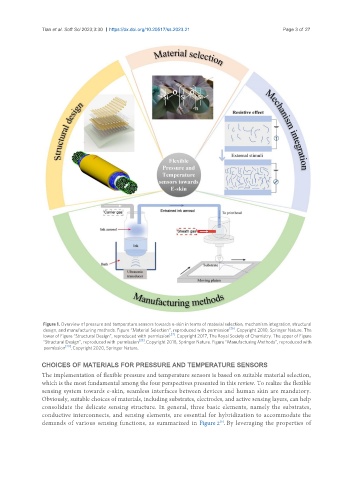
                Figure 1. Overview of pressure and temperature sensors towards e-skin in terms of material selection, mechanism integration, structural
                design, and manufacturing methods. Figure “Material Selection”, reproduced with permission [26] . Copyright 2010, Springer Nature. The
                lower of Figure “Structural Design”, reproduced with permission [27] . Copyright 2017, The Royal Society of Chemistry. The upper of Figure
                “Structural Design”, reproduced with permission [28] . Copyright 2018, Springer Nature. Figure “Manufacturing Methods”, reproduced with
                permission [29] . Copyright 2020, Springer Nature.

               CHOICES OF MATERIALS FOR PRESSURE AND TEMPERATURE SENSORS
               The implementation of flexible pressure and temperature sensors is based on suitable material selection,
               which is the most fundamental among the four perspectives presented in this review. To realize the flexible
               sensing system towards e-skin, seamless interfaces between devices and human skin are mandatory.
               Obviously, suitable choices of materials, including substrates, electrodes, and active sensing layers, can help
               consolidate the delicate sensing structure. In general, three basic elements, namely the substrates,
               conductive interconnects, and sensing elements, are essential for hybridization to accommodate the
               demands of various sensing functions, as summarized in Figure 2 . By leveraging the properties of
                                                                           [3]

