


Page 133 - Read Online
P. 133
Page 8 of 27                             Tian et al. Soft Sci 2023;3:30  https://dx.doi.org/10.20517/ss.2023.21

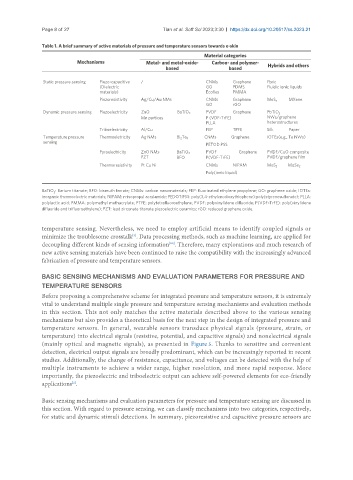
               Table 1. A brief summary of active materials of pressure and temperature sensors towards e-skin
                                                                      Material categories
                           Mechanisms             Metal- and metal-oxide-  Carbon- and polymer-
                                                         based                based        Hybrids and others

                Static pressure sensing  Piezo-capacitive   /         CNMs      Graphene   Fbric
                                   (Dielectric                        GO          PDMS     Fluidic ionic liquids
                                   materials)                         Ecoflex   PMMA
                                   Piezoresistivity  Ag/Cu/Au NMs     CNMs      Graphene   MoS 2  MXene
                                                                      GO        rGO
                Dynamic pressure sensing  Piezoelectricity  ZnO   BaTiO 3  PVDF   Graphene  PbTiO   3
                                                 Mn partices          P (VDF-TrFE)         NWs/graphene
                                                                      PLLA                 heterostructures
                                   Triboelectricity  Al/Cu            FEP       TPFE       Silk   Paper
                Temperature pressure   Thermoeletricity  Ag NMs   Bi 2 Te 3  CNMs   Graphene  IOTEs(e.g., Te NWs)
                sensing
                                                                      PETOD:PSS
                                   Pyroelectricity  ZnO NMs      BaTiO 3  PVDF    Graphene  PVDF/CuO composite
                                                 PZT         BFO      P(VDF-TrFE)          PVDF/graphene film
                                   Thermoresistivity  Pt Cu Ni        CNMs      NIPAM      MoS 2    MoSe 2
                                                                      Poly(ionic liquid)


               BaTiO : Barium titanate; BFO: bismuth ferrate; CNMs: carbon nanomaterials; FEP: fluorinated ethylene propylene; GO: graphene oxide; IOTEs:
                   3
               inorganic thermoelectric materials; NIPAM: n-isopropyl acrylamide; PEDOT:PSS: poly(3,4-ethylenedioxythiophene):poly(styrenesulfonate); PLLA:
               polylactic acid; PMMA: polymethyl methacrylate; PTFE: polytetrafluoroethylene; PVDF: polyvinylidene difluoride; P(VDF-TrFE): poly(vinylidene
               difluoride and trifluoroethylene); PZT: lead zirconate titanate piezoelectric ceramics; rGO: reduced graphene oxide.

               temperature sensing. Nevertheless, we need to employ artificial means to identify coupled signals or
                                              [3]
               minimize the troublesome crosstalk . Data processing methods, such as machine learning, are applied for
                                                          [68]
               decoupling different kinds of sensing information . Therefore, many explorations and much research of
               new active sensing materials have been continued to raise the compatibility with the increasingly advanced
               fabrication of pressure and temperature sensors.


               BASIC SENSING MECHANISMS AND EVALUATION PARAMETERS FOR PRESSURE AND
               TEMPERATURE SENSORS
               Before proposing a comprehensive scheme for integrated pressure and temperature sensors, it is extremely
               vital to understand multiple single pressure and temperature sensing mechanisms and evaluation methods
               in this section. This not only matches the active materials described above to the various sensing
               mechanisms but also provides a theoretical basis for the next step in the design of integrated pressure and
               temperature sensors. In general, wearable sensors transduce physical signals (pressure, strain, or
               temperature) into electrical signals (resistive, potential, and capacitive signals) and nonelectrical signals
               (mainly optical and magnetic signals), as presented in Figure 5. Thanks to sensitive and convenient
               detection, electrical output signals are broadly predominant, which can be increasingly reported in recent
               studies. Additionally, the change of resistance, capacitance, and voltages can be detected with the help of
               multiple instruments to achieve a wider range, higher resolution, and more rapid response. More
               importantly, the piezoelectric and triboelectric output can achieve self-powered elements for eco-friendly
               applications .
                         [2]

               Basic sensing mechanisms and evaluation parameters for pressure and temperature sensing are discussed in
               this section. With regard to pressure sensing, we can classify mechanisms into two categories, respectively,
               for static and dynamic stimuli detections. In summary, piezoresistive and capacitive pressure sensors are

