


Page 135 - Read Online
P. 135
Page 10 of 27                            Tian et al. Soft Sci 2023;3:30  https://dx.doi.org/10.20517/ss.2023.21

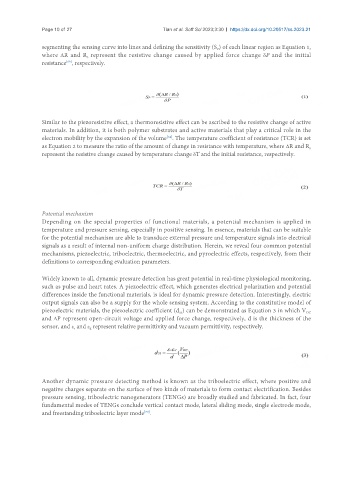
               segmenting the sensing curve into lines and defining the sensitivity (S ) of each linear region as Equation 1,
                                                                          P
               where  ΔR and R  represent the resistive change caused by applied force change  δP and the initial
                              0
                       [69]
               resistance , respectively.


               Similar to the piezoresistive effect, a thermoresistive effect can be ascribed to the resistive change of active
               materials. In addition, it is both polymer substrates and active materials that play a critical role in the
               electron mobility by the expansion of the volume . The temperature coefficient of resistance (TCR) is set
                                                         [64]
               as Equation 2 to measure the ratio of the amount of change in resistance with temperature, where ΔR and R
                                                                                                         0
               represent the resistive change caused by temperature change δT and the initial resistance, respectively.


               Potential mechanism
               Depending on the special properties of functional materials, a potential mechanism is applied in
               temperature and pressure sensing, especially in positive sensing. In essence, materials that can be suitable
               for the potential mechanism are able to transduce external pressure and temperature signals into electrical
               signals as a result of internal non-uniform charge distribution. Herein, we reveal four common potential
               mechanisms, piezoelectric, triboelectric, thermoelectric, and pyroelectric effects, respectively, from their
               definitions to corresponding evaluation parameters.


               Widely known to all, dynamic pressure detection has great potential in real-time physiological monitoring,
               such as pulse and heart rates. A piezoelectric effect, which generates electrical polarization and potential
               differences inside the functional materials, is ideal for dynamic pressure detection. Interestingly, electric
               output signals can also be a supply for the whole sensing system. According to the constitutive model of
               piezoelectric materials, the piezoelectric coefficient (d ) can be demonstrated as Equation 3 in which V
                                                             33
                                                                                                        OC
               and ΔP represent open-circuit voltage and applied force change, respectively, d is the thickness of the
               sensor, and ε  and ε  represent relative permittivity and vacuum permittivity, respectively.
                               d
                          r


               Another dynamic pressure detecting method is known as the triboelectric effect, where positive and
               negative charges separate on the surface of two kinds of materials to form contact electrification. Besides
               pressure sensing, triboelectric nanogenerators (TENGs) are broadly studied and fabricated. In fact, four
               fundamental modes of TENGs conclude vertical contact mode, lateral sliding mode, single electrode mode,
                                                  [70]
               and freestanding triboelectric layer mode .

