


Page 277 - Read Online
P. 277
Page 14 of 21        Duparchy et al. Energy Mater. 2025, 5, 500134  https://dx.doi.org/10.20517/energymater.2025.51

               Table 3. Nominal composition, sample labelling, room temperature charge carrier concentration n , Hall mobility μ  at room
                                                                                       H
                                                                                                   H
               temperature and density of states effective mass         of Mg 1.95 Si 0.233 Sn Sb 0.06 -II and Mg-rich doped samples before and after Mg
                                                                 0.7
               loss from Sankhla et al. [57]
                                                                                         2
                Nominal composition          Sample labelling      n  × 10  (cm )   μ  (cm /Vs)               (m )
                                                                             -3
                                                                         20
                                                                                     H
                                                                    H
                                                                                                      0
                Mg 1.95 Si 0.233 Sn Sb 0.067  Sample 1 [Mg-poor]   2.5              52.3          2.1
                        0.7
                Mg 2.06 Si 0.385 Sn Sb 0.015    Sample 2 [Mg-rich]  2.0             49.2          2.4
                         0.6
                before Mg loss
                Mg 2.06 Si 0.385 Sn Sb 0.015    Sample 2 [after Mg loss]  1.5       41.0          2.4
                         0.6
                after intermediate Mg loss
                Mg 2.06 Si 0.385 Sn Sb 0.015    Sample 2 [Mg-depleted]  0.3         -             1.8
                         0.6
                after Mg loss - fully Mg depleted


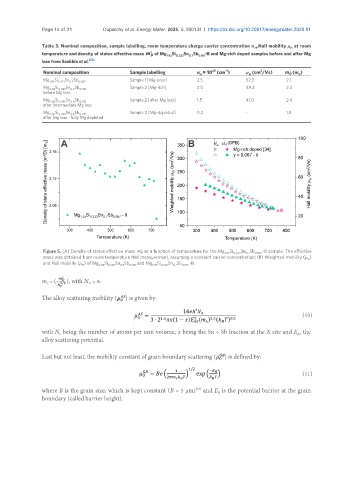
                Figure 5. (A) Density of states effective mass       as a function of temperature for the Mg  Si  Sn Sb  -II sample. The effective
                                                                             1.95  0.233  0.7  0.067
                mass was obtained from room temperature Hall measurement, assuming a constant carrier concentration; (B) Weighted mobility (μ )
                                                                                                         w
                and Hall mobility (μ ) of Mg 2.06 Si 0.385 Sn Sb 0.015  and Mg 1.95 Si 0.233 Sn Sb 0.067 -II.
                                                           0.7
                             H
                                          0.6
               m  = (       ), with N  = 6.
                 s
                               V
               The alloy scattering mobility (      ) is given by:

                                                                                                       (10)

               with N  being the number of atoms per unit volume, x being the Sn + Sb fraction at the X site and E  the
                                                                                                     AS
                     0
               alloy scattering potential.
               Last but not least, the mobility constant of grain boundary scattering (      ) is defined by:


                                                                                                       (11)

               where B is the grain size, which is kept constant (B = 5 µm)  and E  is the potential barrier at the grain
                                                                   [57]
                                                                           B
               boundary (called barrier height).

