


Page 276 - Read Online
P. 276
Duparchy et al. Energy Mater. 2025, 5, 500134  https://dx.doi.org/10.20517/energymater.2025.51  Page 13 of 21

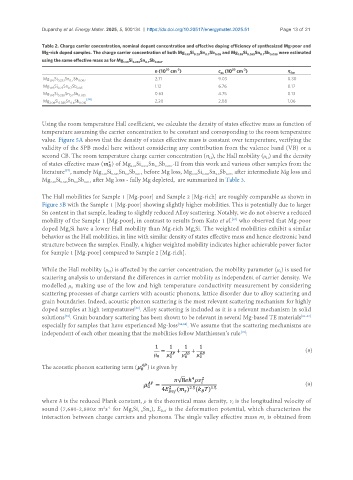
               Table 2. Charge carrier concentration, nominal dopant concentration and effective doping efficiency of synthesized Mg-poor and
               Mg-rich doped samples. The charge carrier concentration of both Mg 1.95 Si 0.25 Sn Sb 0.05  and Mg 1.95 Si 0.265 Sn Sb 0.035  were estimated
                                                                      0.7
                                                                                         0.7
               using the same effective mass as for Mg 1.95 Si 0.233 Sn Sb 0.067
                                                  0.7
                                                     n (10  cm )           c  (10  cm )           η dop
                                                         20
                                                             -3
                                                                                   -3
                                                                               20
                                                                           Sb
                Mg 1.95 Si 0.233 Sn Sb 0.067         2.71                  9.03                   0.30
                        0.7
                Mg 1.95 Si 0.25 Sn Sb 0.05           1.12                  6.76                   0.17
                        0.7
                Mg 1.95 Si 0.265 Sn Sb 0.035         0.63                  4.75                   0.13
                        0.7
                Mg 2.06 Si 0.385 Sn Sb 0.015 [34]    2.20                  2.08                   1.06
                         0.6
               Using the room temperature Hall coefficient, we calculate the density of states effective mass as function of
               temperature assuming the carrier concentration to be constant and corresponding to the room temperature
               value. Figure 5A shows that the density of states effective mass is constant over temperature, verifying the
               validity of the SPB model here without considering any contribution from the valence band (VB) or a
               second CB. The room temperature charge carrier concentration (n ), the Hall mobility (μ ) and the density
                                                                        H
                                                                                           H
               of states effective mass (     ) of Mg Si Sn Sb -II from this work and various other samples from the
                                                 0.233
                                                         0.067
                                                     0.7
                                             1.95
               literature , namely Mg Si Sn Sb  before Mg loss, Mg Si Sn Sb  after intermediate Mg loss and
                       [57]
                                   2.06
                                                                             0.015
                                                                          0.6
                                               0.015
                                           0.6
                                       0.385
                                                                  2.06
                                                                     0.385
               Mg Si Sn Sb  after Mg loss - fully Mg depleted,  are summarized in Table 3.
                             0.015
                     0.385
                  2.06
                          0.6
               The Hall mobilities for Sample 1 [Mg-poor] and Sample 2 [Mg-rich] are roughly comparable as shown in
               Figure 5B with the Sample 1 [Mg-poor] showing slightly higher mobilities. This is potentially due to larger
               Sn content in that sample, leading to slightly reduced Alloy scattering. Notably, we do not observe a reduced
                                                                               [67]
               mobility of the Sample 1 [Mg-poor], in contrast to results from Kato et al.  who observed that Mg-poor
               doped Mg Si have a lower Hall mobility than Mg-rich Mg Si. The weighted mobilities exhibit a similar
                        2
                                                                  2
               behavior as the Hall mobilities, in line with similar density of states effective mass and hence electronic band
               structure between the samples. Finally, a higher weighted mobility indicates higher achievable power factor
               for Sample 1 [Mg-poor] compared to Sample 2 [Mg-rich].
               While the Hall mobility (μ ) is affected by the carrier concentration, the mobility parameter (μ ) is used for
                                                                                               0
                                      H
               scattering analysis to understand the differences in carrier mobility as independent of carrier density. We
               modelled μ  making use of the low and high temperature conductivity measurement by considering
                         0
               scattering processes of charge carriers with acoustic phonons, lattice disorder due to alloy scattering and
               grain boundaries. Indeed, acoustic phonon scattering is the most relevant scattering mechanism for highly
               doped samples at high temperatures . Alloy scattering is included as it is a relevant mechanism in solid
                                              [80]
                       [78]
               solutions . Grain boundary scattering has been shown to be relevant in several Mg-based TE materials [81-83]
               especially for samples that have experienced Mg-loss [34,84] . We assume that the scattering mechanisms are
                                                                                  [76]
               independent of each other meaning that the mobilities follow Matthiessen’s rule :
                                                                                                        (8)
               The acoustic phonon scattering term (       ) is given by
                                                                                                        (9)
               where ħ is the reduced Plank constant, ρ is the theoretical mass density, v is the longitudinal velocity of
                                                                               l
               sound (7,680-2,880x m s  for Mg Si Sn ), E  is the deformation potential, which characterizes the
                                    2 -1
                                             2
                                                       Def
                                                1-x
                                                   x
               interaction between charge carriers and phonons. The single valley effective mass m  is obtained from
                                                                                          s

