


Page 275 - Read Online
P. 275
Page 12 of 21        Duparchy et al. Energy Mater. 2025, 5, 500134  https://dx.doi.org/10.20517/energymater.2025.51

               reproducibility as no excess or loosely bound Mg is lost during the sintering step.

               We have calculated the effective doping efficiency (η ) [Table 2] of Sb from the (measured) carrier
                                                               dop
               concentration n and the nominal dopant concentration under the assumption that each Sb atom replaces
               one Si/Sn atom and provides one electron, using η  =       with c  =       the dopant concentration. The
                                                                        Sb
                                                           dop
               effective doping efficiency is much lower for the synthesized Mg-poor samples than for the synthesized
               Mg-rich materials, which could be caused by Sb becoming electrically inactive (i.e., does not act as a donor
               anymore). However, if this was the case, comparing the different Mg-poor samples we should see an
               increase of the doping efficiency with decreasing Sb content, which is not observed. Also, density functional
               theory (DFT) calculations from Ayachi et al.  indeed show a change from +1 to neutral for Sb  and Sb  for
                                                    [75]
                                                                                                      Sn
                                                                                               Si
               high Fermi levels (i.e., large carrier concentrations), but these charge transition levels are similar for
               Mg-rich and Mg-poor materials, hence, Sb becoming inactive is probably not the reason for the decrease in
               doping efficiency. A more plausible reason could be the formation of compensating defects with increasing
                                                         [29]
                                                                            [48]
               Sb content. This has been observed by Kato et al.  and Dasgupta et al.  who showed experimentally that
               Mg vacancies increase with increasing Sb doping, for nominal Mg-rich samples. Also for Mg-poor samples
               an increase of p-type Mg vacancies is expected with increasing carrier concentration caused by increasing
               Sb content, leading to a partial compensation of the free electrons from Sb addition.


               The transport data of Mg Si 0.233 Sn Sb 0.067 -II (sample on which Hall measurement was performed) were
                                     1.95
                                              0.7
               investigated for differences in the microscopic material parameters using a single parabolic Band (SPB)
               model with respect to previously reported data for Mg-rich samples and those extracted from the samples
                                                      [57]
               after annealing, i.e., presumably Mg-poor . This composition was chosen as it leads to the best
               thermoelectric performance in the material. As no thermal conductivity measurements were performed on
               that sample, the data of Mg Si Sn Sb -I (with almost identical electrical properties) was utilized
                                                0.7
                                                   0.067
                                           0.233
                                        1.95
               instead.
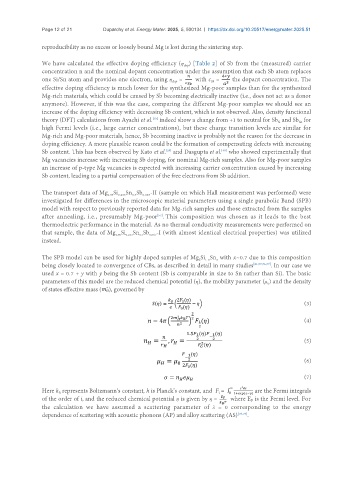
               The SPB model can be used for highly doped samples of Mg Si Sn  with x~0.7 due to this composition
                                                                      1-x
                                                                          x
                                                                    2
               being closely located to convergence of CBs, as described in detail in many studies [21,57,76,77] . In our case we
               used x = 0.7 + y with y being the Sb content (Sb is comparable in size to Sn rather than Si). The basic
               parameters of this model are the reduced chemical potential (η), the mobility parameter (μ ) and the density
                                                                                           0
               of states effective mass (     ), governed by
                                                                                                        (3)


                                                                                                        (4)


                                                                                                        (5)


                                                                                                        (6)

                                                                                                        (7)

               Here k  represents Boltzmann’s constant, h is Planck’s constant, and  F =                    are the Fermi integrals
                                                                           i
                     B
               of the order of i, and the reduced chemical potential η is given by η =   where E F  is the Fermi level. For
               the  calculation  we  have  assumed  a  scattering  parameter  of  λ  =  0  corresponding  to  the  energy
               dependence of scattering with acoustic phonons (AP) and alloy scattering (AS) [78,79] .

