


Page 279 - Read Online
P. 279
Page 16 of 21        Duparchy et al. Energy Mater. 2025, 5, 500134  https://dx.doi.org/10.20517/energymater.2025.51


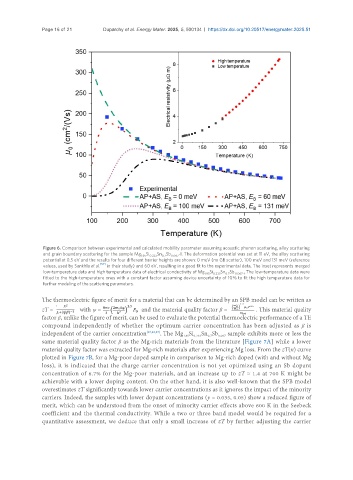
                Figure 6. Comparison between experimental and calculated mobility parameter assuming acoustic phonon scattering, alloy scattering
                and grain boundary scattering for the sample Mg 1.95 Si 0.233 Sn Sb 0.067 -I. The deformation potential was set at 11 eV, the alloy scattering
                                                        0.7
                potential at 0.5 eV and the results for four different barrier heights are shown: 0 meV (no GB scatter), 100 meV and 131 meV (reference
                values, used by Sankhla et al. [57]  in their study) and 60 eV, resulting in a good fit to the experimental data. The inset represents merged
                low-temperature data and high temperature data of electrical conductivity of Mg 1.95 Si 0.233 Sn Sb  0.067-I . The low-temperature data were
                                                                             0.7
                fitted to the high-temperature ones with a constant factor assuming device uncertainty of 10% to fit the high temperature data for
                further modeling of the scattering parameters.
               The thermoelectric figure of merit for a material that can be determined by an SPB model can be written as
               zT =                with ψ =                        and the material quality factor β =                 . This material quality
               factor β, unlike the figure of merit, can be used to evaluate the potential thermoelectric performance of a TE
               compound independently of whether the optimum carrier concentration has been adjusted as  β is
               independent of the carrier concentration [57,58,87] . The Mg Si 0.233 Sn Sb 0.067  sample exhibits more or less the
                                                               1.95
                                                                       0.7
               same material quality factor β as the Mg-rich materials from the literature [Figure 7A] while a lower
               material quality factor was extracted for Mg-rich materials after experiencing Mg loss. From the zT(n) curve
               plotted in Figure 7B, for a Mg-poor doped sample in comparison to Mg-rich doped (with and without Mg
               loss), it is indicated that the charge carrier concentration is not yet optimized using an Sb dopant
               concentration of 6.7% for the Mg-poor materials, and an increase up to zT ≈ 1.4 at 700 K might be
               achievable with a lower doping content. On the other hand, it is also well-known that the SPB model
               overestimates zT significantly towards lower carrier concentrations as it ignores the impact of the minority
               carriers. Indeed, the samples with lower dopant concentrations (y = 0.035, 0.05) show a reduced figure of
               merit, which can be understood from the onset of minority carrier effects above 600 K in the Seebeck
               coefficient and the thermal conductivity. While a two or three band model would be required for a
               quantitative assessment, we deduce that only a small increase of zT by further adjusting the carrier

