


Page 280 - Read Online
P. 280
Duparchy et al. Energy Mater. 2025, 5, 500134  https://dx.doi.org/10.20517/energymater.2025.51  Page 17 of 21


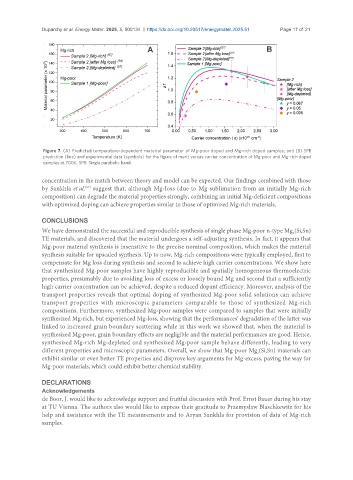
                Figure 7. (A) Predicted temperature-dependent material parameter of Mg-poor doped and Mg-rich doped samples; and (B) SPB
                prediction (line) and experimental data (symbols) for the figure of merit versus carrier concentration of Mg-poor and Mg-rich doped
                samples at 700K. SPB: Single parabolic band.

               concentration in the match between theory and model can be expected. Our findings combined with those
               by Sankhla et al.  suggest that, although Mg-loss (due to Mg sublimation from an initially Mg-rich
                              [57]
               composition) can degrade the material properties strongly, combining an initial Mg-deficient compositions
               with optimized doping can achieve properties similar to those of optimized Mg-rich materials.


               CONCLUSIONS
               We have demonstrated the successful and reproducible synthesis of single phase Mg-poor n-type Mg (Si,Sn)
                                                                                                    2
               TE materials, and discovered that the material undergoes a self-adjusting synthesis. In fact, it appears that
               Mg-poor material synthesis is insensitive to the precise nominal composition, which makes the material
               synthesis suitable for upscaled synthesis. Up to now, Mg-rich compositions were typically employed, first to
               compensate for Mg loss during synthesis and second to achieve high carrier concentrations. We show here
               that synthesized Mg-poor samples have highly reproducible and spatially homogeneous thermoelectric
               properties, presumably due to avoiding loss of excess or loosely bound Mg and second that a sufficiently
               high carrier concentration can be achieved, despite a reduced dopant efficiency. Moreover, analysis of the
               transport properties reveals that optimal doping of synthesized Mg-poor solid solutions can achieve
               transport  properties  with  microscopic  parameters  comparable  to  those  of  synthesized  Mg-rich
               compositions. Furthermore, synthesized Mg-poor samples were compared to samples that were initially
               synthesized Mg-rich, but experienced Mg-loss, showing that the performances’ degradation of the latter was
               linked to increased grain boundary scattering while in this work we showed that, when the material is
               synthesized Mg-poor, grain boundary effects are negligible and the material performances are good. Hence,
               synthesized Mg-rich Mg-depleted and synthesized Mg-poor sample behave differently, leading to very
               different properties and microscopic parameters. Overall, we show that Mg-poor Mg (Si,Sn) materials can
                                                                                        2
               exhibit similar or even better TE properties and disprove key arguments for Mg-excess, paving the way for
               Mg-poor materials, which could exhibit better chemical stability.


               DECLARATIONS
               Acknowledgements
               de Boor, J. would like to acknowledge support and fruitful discussion with Prof. Ernst Bauer during his stay
               at TU Vienna. The authors also would like to express their gratitude to Przemyslaw Blaschkewitz for his
               help and assistance with the TE measurements and to Aryan Sankhla for provision of data of Mg-rich
               samples.

