


Page 272 - Read Online
P. 272
Duparchy et al. Energy Mater. 2025, 5, 500134  https://dx.doi.org/10.20517/energymater.2025.51  Page 9 of 21


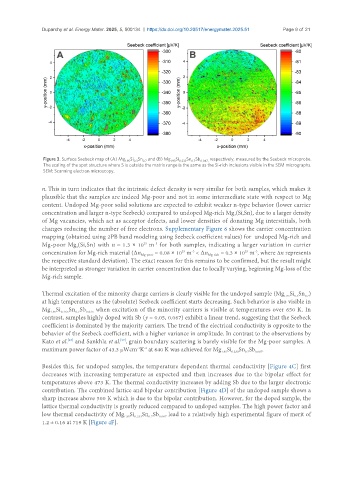
                Figure 3. Surface Seebeck map of (A) Mg  Si Sn  and (B) Mg  Si  Sn Sb   respectively, measured by the Seebeck microprobe.
                                           1.95  0.3  0.7  1.95  0.233  0.7  0.067,
                The scaling of the spot structure where S is outside the matrix range is the same as the Si-rich inclusions visible in the SEM micrographs.
                SEM: Scanning electron microscopy.

               n. This in turn indicates that the intrinsic defect density is very similar for both samples, which makes it
               plausible that the samples are indeed Mg-poor and not in some intermediate state with respect to Mg
               content. Undoped Mg-poor solid solutions are expected to exhibit weaker n-type behavior (lower carrier
               concentration and larger n-type Seebeck) compared to undoped Mg-rich Mg (Si,Sn), due to a larger density
                                                                                2
               of Mg vacancies, which act as acceptor defects, and lower densities of donating Mg interstitials, both
               changes reducing the number of free electrons. Supplementary Figure 6 shows the carrier concentration
               mapping (obtained using 2PB band modeling using Seebeck coefficient values) for  undoped Mg-rich and
               Mg-poor Mg (Si,Sn) with n ≈ 1.3 × 10  m  for both samples, indicating a larger variation in carrier
                                                     -3
                                                 25
                           2
                                                                                    25
                                                                                       -3
                                                                  -3
                                                              25
               concentration for Mg-rich material (∆n Mg-poor  = 0.08 × 10  m  < ∆n Mg-rich  = 0.3 × 10  m , where Δn represents
               the respective standard deviation). The exact reason for this remains to be confirmed, but the result might
               be interpreted as stronger variation in carrier concentration due to locally varying, beginning Mg-loss of the
               Mg-rich sample.
               Thermal excitation of the minority charge carriers is clearly visible for the undoped sample (Mg Si Sn )
                                                                                                    0.3
                                                                                                        0.7
                                                                                                 1.95
               at high temperatures as the (absolute) Seebeck coefficient starts decreasing. Such behavior is also visible in
               Mg Si  0.265 Sn Sb 0.035  when excitation of the minority carriers is visible at temperatures over 650 K. In
                          0.7
                  1.95
               contrast, samples highly doped with Sb (y = 0.05, 0.067) exhibit a linear trend, suggesting that the Seebeck
               coefficient is dominated by the majority carriers. The trend of the electrical conductivity is opposite to the
               behavior of the Seebeck coefficient, with a higher variance in amplitude. In contrast to the observations by
               Kato et al.  and Sankhla et al. , grain boundary scattering is barely visible for the Mg-poor samples. A
                        [67]
                                          [57]
                                                  -2
               maximum power factor of 43.3 µWcm K  at 640 K was achieved for Mg Si Sn Sb .
                                               -1
                                                                            1.95
                                                                               0.233
                                                                                       0.067
                                                                                    0.7
               Besides this, for undoped samples, the temperature dependent thermal conductivity [Figure 4C] first
               decreases with increasing temperature as expected and then increases due to the bipolar effect for
               temperatures above 473 K. The thermal conductivity increases by adding Sb due to the larger electronic
               contribution. The combined lattice and bipolar contribution [Figure 4D] of the undoped sample shows a
               sharp increase above 500 K which is due to the bipolar contribution. However, for the doped sample, the
               lattice thermal conductivity is greatly reduced compared to undoped samples. The high power factor and
               low thermal conductivity of Mg Si 0.233 Sn Sb 0.067  lead to a relatively high experimental figure of merit of
                                           1.95
                                                   0.7
               1.2 ± 0.16 at 719 K [Figure 4F].

