


Page 268 - Read Online
P. 268
Duparchy et al. Energy Mater. 2025, 5, 500134  https://dx.doi.org/10.20517/energymater.2025.51  Page 5 of 21

               resolution of 50 µm [52,53] . The temperature-dependent electrical conductivity (σ) and Seebeck coefficient (S)
               between room temperature and 723 K were measured using an in-house developed device with a four-probe
               technique under helium atmosphere, at Deutsches Zentrum für Luft und Raumfahrt (DLR) [54,55] . Low
                                                                                                        [56]
               temperature measurements were performed in another home-made apparatuses as described in ,
               developed by Parzer et al. at TU Wien. As shown in Supplementary Figure 1, it shows good agreement of
               both Seebeck coefficient and electrical conductivity to high temperature measurement in both cases, with
               differences < 10% providing evidence on good measurement accuracy. The thermal diffusivity (α)
               measurement was performed using a laser flash method (Netzsch LFA 427 apparatus) in argon atmosphere.
               From this, the thermal conductivity (κ) was calculated using κ = αρC , where ρ and C  are the sample density
                                                                                      p
                                                                        p
               and heat capacity dependent on the composition at constant pressure, respectively. C  was calculated using
                                                                                       p
               the Dulong-Petit limit estimating the specific heat at constant volume (   ) and a thermal expansion
               correction: C  =                    , E                             10  K  and                               10  Pa where E  and β  are
                                                                                        -1
                                                                                    -11
                                                             -1
                                                          -5
                                                                                                t
                           P
                                                                                                      T
               the linear coefficient of thermal expansion and isothermal compressibility of Mg Si Sn  respectively. The
                                                                                      0.3
                                                                                          0.7
                                                                                    2
               electronic thermal conductivity was estimated by the Wiedemann-Franz law by κ  = LσT where L is the
                                                                                      e
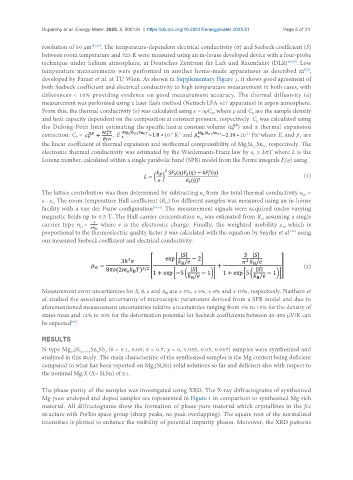
               Lorenz number, calculated within a single parabolic band (SPB) model from the Fermi integrals F(η) using
                                                                                                 i
                                                                                                       (1)
               The lattice contribution was then determined by subtracting κ  from the total thermal conductivity κ  =
                                                                     e
                                                                                                       lat
               κ - κ . The room-temperature Hall coefficient (R ) for different samples was measured using an in-house
                   e
                                                         H
               facility with a van der Pauw configuration [34,57] . The measurement signals were acquired under varying
               magnetic fields up to 0.5 T. The Hall carrier concentration n  was estimated from R  assuming a single
                                                                                         H
                                                                    H
               carrier type n  =         where e is the electronic charge. Finally, the weighted mobility  μ , which is
                                                                                                w
                            H
                                                                                                   [58]
               proportional to the thermoelectric quality factor β was calculated with the equation by Snyder et al.  using
               our measured Seebeck coefficient and electrical conductivity.
                                                                                                       (2)
               Measurement error uncertainties for S, σ, κ and n  are ± 5%, ± 5%, ± 8% and ± 10%, respectively. Naithani et
                                                         H
               al. studied the associated uncertainty of microscopic parameters derived from a SPB model and due to
               aforementioned measurement uncertainties relative uncertainties ranging from 5% to 15% for the density of
               states mass and 12% to 20% for the deformation potential for Seebeck coefficients between 40-400 µV/K can
               be expected .
                         [59]

               RESULTS
               N-type Mg Si 0.3-x-y Sn Sb  (δ = 0.1, 0.05; x = 0.7; y = 0, 0.035, 0.05, 0.067) samples were synthesized and
                         2-δ
                                    y
                                  x
               analyzed in this study. The main characteristic of the synthesized samples is the Mg content being deficient
               compared to what has been reported on Mg (Si,Sn) solid solutions so far and deficient also with respect to
                                                     2
               the nominal Mg:X (X= Si,Sn) of 2:1.
               The phase purity of the samples was investigated using XRD. The X-ray diffractograms of synthesized
               Mg-poor undoped and doped samples are represented in Figure 1 in comparison to synthesized Mg-rich
               material. All diffractograms show the formation of phase-pure material which crystallizes in the fcc
               structure with Fm  m space group (sharp peaks, no peak overlapping). The square root of the normalized
               intensities is plotted to enhance the visibility of potential impurity phases. Moreover, the XRD patterns

