


Page 88 - Read Online
P. 88
Page 34 of 50                      Siddiqui et al. Chem Synth 2023;3:25  https://dx.doi.org/10.20517/cs.2023.02


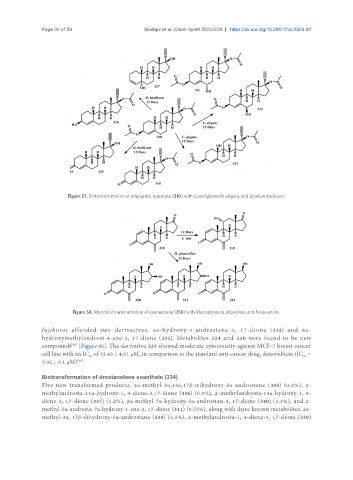
                        Figure 57. Biotransformation of ethynodiol diacetate (310) with Cunninghamella elegans, and Ocimum basilicum.


                          Figure 58. Microbial transformation of exemestane (318) with Macrophomina phaseolina, and Fusarium lini.


               fujikuroi  afforded  two  derivatives,  6α-hydroxy-4-androstene-3,  17-dione  (332)  and  6α-
               hydroxymethylandrost-4-ene-3, 17-dione (333). Metabolites 324 and 330 were found to be new
                         [80]
               compounds  [Figure 60]. The derivative 325 showed moderate cytotoxicity against MCF-7 breast cancer
               cell line with an IC  of 33.43 ± 4.01 μM, in comparison to the standard anti-cancer drug, doxorubicin (IC  =
                               50
                                                                                                       50
                           [80]
               0.92 ± 0.1 μM) .
               Biotransformation of drostanolone enanthate (334)
               Five new transformed products, 2α-methyl-3α,14α,17β-trihydroxy-5α-androstane (335) (0.8%), 2-
               methylandrosta-11α-hydroxy-1, 4-diene-3,17-dione (336) (0.9%), 2-methylandrosta-14α-hydroxy-1, 4-
               diene-3, 17-dione (337) (1.2%), 2α-methyl-7α-hydroxy-5α-androstan-3, 17-dione (340) (1.1%), and 2-
               methyl-5α-androsta-7α-hydroxy-1-ene-3, 17-dione (341) (0.75%), along with three known metabolites, 2α-
               methyl-3α, 17β-dihydroxy-5α-androstane (338) (3.5%), 2-methylandrosta-1, 4-diene-3, 17-dione (339)

