


Page 89 - Read Online
P. 89
Siddiqui et al. Chem Synth 2023;3:25  https://dx.doi.org/10.20517/cs.2023.02    Page 35 of 50


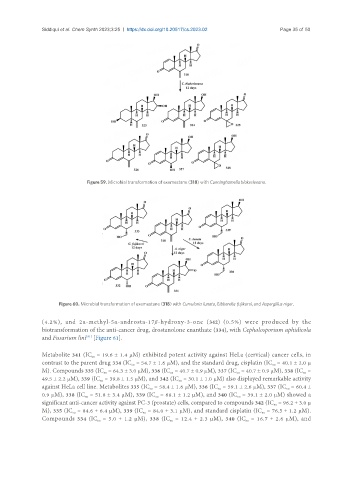
                              Figure 59. Microbial transformation of exemestane (318) with Cunninghamella blakesleeana.


                     Figure 60. Microbial transformation of exemestane (318) with Curvularia lunata, Gibberella fujikuroi, and Aspergillus niger.

               (4.2%),  and  2α-methyl-5α-androsta-17β-hydroxy-3-one  (342)  (0.5%)  were  produced  by  the
               biotransformation of the anti-cancer drug, drostanolone enanthate (334), with Cephalosporium aphidicola
                              [81]
               and Fusarium lini  [Figure 61].

               Metabolite 341 (IC  = 19.6 ± 1.4 µM) exhibited potent activity against HeLa (cervical) cancer cells, in
                                50
               contrast to the parent drug 334 (IC  = 54.7 ± 1.6 µM), and the standard drug, cisplatin (IC  = 40.1 ± 2.0 µ
                                                                                             50
                                             50
               M). Compounds 335 (IC  = 64.3 ± 3.0 µM), 336 (IC  = 40.7 ± 0.9 µM), 337 (IC  = 40.7 ± 0.9 µM), 338 (IC  =
                                    50
                                                                                 50
                                                          50
                                                                                                       50
               49.5 ± 2.2 µM), 339 (IC  = 39.8 ± 1.5 µM), and 342 (IC  = 30.1 ± 1.0 µM) also displayed remarkable activity
                                   50
                                                             50
               against HeLa cell line. Metabolites 335 (IC  = 58.4 ± 1.6 µM), 336 (IC  = 59.1 ± 2.6 µM), 337 (IC  = 60.4 ±
                                                   50
                                                                          50
                                                                                                  50
               0.9 µM), 338 (IC  = 51.8 ± 3.4 µM), 339 (IC  = 68.1 ± 1.2 µM), and 340 (IC  = 39.1 ± 2.0 µM) showed a
                                                                                 50
                                                     50
                              50
               significant anti-cancer activity against PC-3 (prostate) cells, compared to compounds 342 (IC  = 96.2 ± 3.0 µ
                                                                                             50
               M), 335 (IC  = 84.6 ± 6.4 µM), 339 (IC  = 84.0 ± 3.1 µM), and standard cisplatin (IC  = 76.5 ± 1.2 µM).
                                                                                         50
                                                 50
                         50
               Compounds 334 (IC  = 5.0  ± 1.2  µM), 338 (IC  = 12.4  ± 2.3  µM), 340 (IC  = 16.7  ± 2.6  µM), and
                                                                                    50
                                                          50
                                  50

