


Page 90 - Read Online
P. 90
Page 36 of 50                      Siddiqui et al. Chem Synth 2023;3:25  https://dx.doi.org/10.20517/cs.2023.02


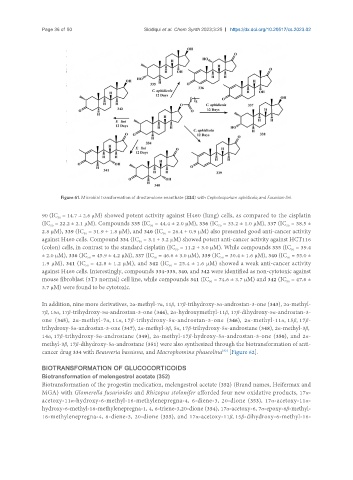
                      Figure 61. Microbial transformation of drostanolone enanthate (334) with Cephalosporium aphidicola, and Fusarium lini.

               90 (IC  = 14.7 ± 2.6 µM) showed potent activity against H460 (lung) cells, as compared to the cisplatin
                    50
               (IC  = 22.2 ± 2.1 µM). Compounds 335 (IC  = 44.4 ± 2.0 µM), 336 (IC  = 33.2 ± 1.0 µM), 337 (IC  = 38.5 ±
                                                                                                  50
                                                    50
                                                                           50
                  50
               2.8 µM), 339 (IC  = 31.9 ± 1.8 µM), and 340 (IC  = 26.4 ± 0.9 µM) also presented good anti-cancer activity
                             50
                                                        50
               against H460 cells. Compound 334 (IC  = 3.1 ± 3.2 µM) showed potent anti-cancer activity against HCT116
                                                50
               (colon) cells, in contrast to the standard cisplatin (IC  = 11.2 ± 3.0 µM). While compounds 335 (IC  = 39.4
                                                            50
                                                                                                   50
               ± 2.0 µM), 336 (IC  = 45.9 ± 4.2 µM), 337 (IC  = 46.6 ± 3.0 µM), 339 (IC  = 30.4 ± 1.6 µM), 340 (IC  = 55.0 ±
                                                                                                  50
                                                     50
                              50
                                                                           50
               1.9 µM), 341 (IC  = 42.8 ± 1.2 µM), and 342 (IC  = 25.4 ± 1.6 µM) showed a weak anti-cancer activity
                              50
                                                          50
               against H460 cells. Interestingly, compounds 334-335, 340, and 342 were identified as non-cytotoxic against
               mouse fibroblast (3T3 normal) cell line, while compounds 341 (IC  = 74.6 ± 3.7 µM) and 342 (IC  = 47.6 ±
                                                                                                  50
                                                                        50
               3.7 µM) were found to be cytotoxic.
               In addition, nine more derivatives, 2α-methyl-7α, 11β, 17β-trihydroxy-5α-androstan-3-one (343), 2α-methyl-
               7β, 15α, 17β-trihydroxy-5α-androstan-3-one (344), 2α-hydroxymethyl-11β, 17β-dihydroxy-5α-androstan-3-
               one  (345),  2α-methyl-7α, 11α, 17β-trihydroxy-5α-androstan-3-one  (346),  2α-methyl-11α, 15β, 17β-
               trihydroxy-5α-androstan-3-one (347), 2α-methyl-3β, 5α, 17β-trihydroxy-5α-androstane (348), 2α-methyl-3β,
               14α, 17β-trihydroxy-5α-androstane (349), 2α-methyl-17β-hydroxy-5α-androstan-3-one (350), and 2α-
               methyl-3β, 17β-dihydroxy-5α-androstane (351) were also synthesized through the biotransformation of anti-
               cancer drug 334 with Beauveria bassiana, and Macrophomina phaseolina  [Figure 62].
                                                                            [82]
               BIOTRANSFORMATION OF GLUCOCORTICOIDS
               Biotransformation of melengestrol acetate (352)
               Biotransformation of the progestin medication, melengestrol acetate (352) (Brand names, Heifermax and
               MGA) with Glomerella fusarioides and Rhizopus stolonifer afforded four new oxidative products, 17α-
               acetoxy-11α-hydroxy-6-methyl-16-methylenepregna-4, 6-diene-3, 20-dione (353), 17α-acetoxy-11α-
               hydroxy-6-methyl-16-methylenepregna-1, 4, 6-triene-3,20-dione (354), 17α-acetoxy-6, 7α-epoxy-6β-methyl-
               16-methylenepregna-4, 6-diene-3, 20-dione (355), and 17α-acetoxy-11β, 15β-dihydroxy-6-methyl-16-

