


Page 87 - Read Online
P. 87
Siddiqui et al. Chem Synth 2023;3:25  https://dx.doi.org/10.20517/cs.2023.02    Page 33 of 50


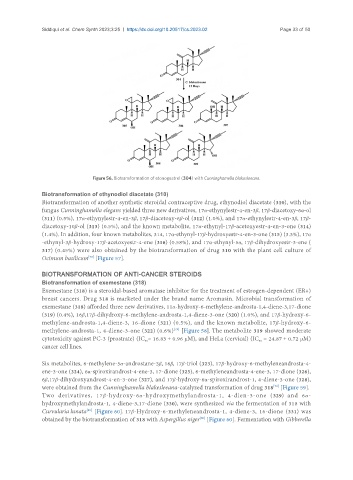
                                Figure 56. Biotransformation of etonogestrel (304) with Cunninghamella blakesleeana.

               Biotransformation of ethynodiol diacetate (310)
               Biotransformation of another synthetic steroidal contraceptive drug, ethynodiol diacetate (310), with the
               fungus Cunninghamella elegans yielded three new derivatives, 17α-ethynylestr-4-en-3β, 17β-diacetoxy-6α-ol
               (311) (0.5%), 17α-ethynylestr-4-en-3β, 17β-diacetoxy-6β-ol (312) (1.0%), and 17α-ethynylestr-4-en-3β, 17β-
               diacetoxy-10β-ol (313) (0.5%), and the known metabolite, 17α-ethynyl-17β-acetoxyestr-4-en-3-one (314)
               (1.4%). In addition, four known metabolites, 314, 17α-ethynyl-17β-hydroxyestr-4-en-3-one (315) (3.3%), 17α
               -ethynyl-3β-hydroxy-17β-acetoxyestr-4-ene (316) (0.58%), and 17α-ethynyl-5α, 17β-dihydroxyestr-3-ene (
               317) (0.45%) were also obtained by the biotransformation of drug 310 with the plant cell culture of
                               [78]
               Ocimum basilicum  [Figure 57].
               BIOTRANSFORMATION OF ANTI-CANCER STEROIDS
               Biotransformation of exemestane (318)
               Exemestane (318) is a steroidal-based aromatase inhibitor for the treatment of estrogen-dependent (ER+)
               breast cancers. Drug 318 is marketed under the brand name Aromasin. Microbial transformation of
               exemestane (318) afforded three new derivatives, 11α-hydroxy-6-methylene-androsta-1,4-diene-3,17-dione
               (319) (0.4%), 16β,17β-dihydroxy-6-methylene-androsta-1,4-diene-3-one (320) (1.0%), and 17β-hydroxy-6-
               methylene-androsta-1,4-diene-3, 16-dione (321) (0.5%), and the known metabolite, 17β-hydroxy-6-
                                                            [79]
               methylene-androsta-1, 4-diene-3-one (322) (0.6%)  [Figure 58]. The metabolite 319 showed moderate
               cytotoxicity against PC-3 (prostrate) (IC = 16.83 ± 0.96 μM), and HeLa (cervical) (IC  = 24.87 ± 0.72 μM)
                                                  50
                                                                                        50
               cancer cell lines.
               Six metabolites, 6-methylene-5α-androstane-3β, 16β, 17β-triol (323), 17β-hydroxy-6-methyleneandrosta-4-
               ene-3-one (324), 6α-spiroxirandrost-4-ene-3, 17-dione (325), 6-methyleneandrosta-4-ene-3, 17-dione (326),
               6β,17β-dihydroxyandrost-4-en-3-one (327), and 17β-hydroxy-6α-spiroxirandrost-1, 4-diene-3-one (328),
               were obtained from the Cunninghamella blakesleeana-catalyzed transformation of drug 318  [Figure 59].
                                                                                             [79]
               Two  derivatives,  17β-hydroxy-6α-hydroxymethylandrosta-1,  4-dien-3-one  (329)  and  6α-
               hydroxymethylandrosta-1, 4-diene-3,17-dione (330), were synthesized via the fermentation of 318 with
               Curvularia lunata  [Figure 60]. 17β-Hydroxy-6-methyleneandrosta-1, 4-diene-3, 16-dione (331) was
                              [80]
               obtained by the biotransformation of 318 with Aspergillus niger  [Figure 60]. Fermentation with Gibberella
                                                                    [80]

