


Page 84 - Read Online
P. 84
Page 30 of 50                      Siddiqui et al. Chem Synth 2023;3:25  https://dx.doi.org/10.20517/cs.2023.02


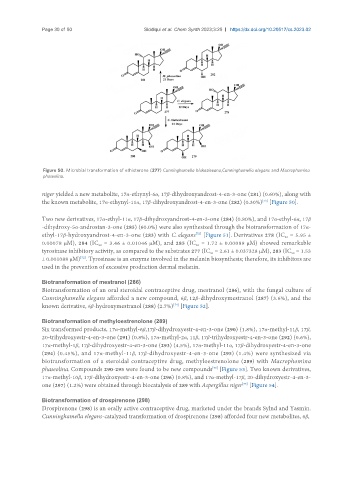
                Figure 50. Microbial transformation of ethisterone (277) Cunninghamella blakesleeana,Cunninghamella elegans and Macrophomina
                phaseolina.

               niger yielded a new metabolite, 17α-ethynyl-6α, 17β-dihydroxyandrost-4-en-3-one (281) (0.60%), along with
                                                                                         [73]
               the known metabolite, 17α-ethynyl-11α, 17β-dihydroxyandrost-4-en-3-one (282) (0.30%)  [Figure 50].

               Two new derivatives, 17α-ethyl-11α, 17β-dihydroxyandrost-4-en-3-one (284) (0.80%), and 17α-ethyl-6α, 17β
               -dihydroxy-5α-androstan-3-one (285) (60.0%) were also synthesized through the biotransformation of 17α-
               ethyl-17β-hydroxyandrost-4-en-3-one (283) with C. elegans  [Figure 51]. Derivatives 278 (IC  = 5.95 ±
                                                                   [72]
                                                                                                 50
               0.00078 μM), 284 (IC  = 3.46 ± 0.01046 μM), and 285 (IC  = 1.72 ± 0.00089 μM) showed remarkable
                                                                   50
                                  50
               tyrosinase inhibitory activity, as compared to the substrates 277 (IC  = 2.61 ± 0.037328 μM), 283 (IC  = 1.53
                                                                        50
                                                                                                   50
               ± 0.001088 μM) . Tyrosinase is an enzyme involved in the melanin biosynthesis; therefore, its inhibitors are
                            [72]
               used in the prevention of excessive production dermal melanin.
               Biotransformation of mestranol (286)
               Biotransformation of an oral steroidal contraceptive drug, mestranol (286), with the fungal culture of
               Cunninghamella elegans afforded a new compound, 6β, 12β-dihydroxymestranol (287) (3.6%), and the
               known derivative, 6β-hydroxymestranol (288) (2.7%)  [Figure 52].
                                                           [74]
               Biotransformation of methyloestrenolone (289)
               Six transformed products, 17α-methyl-6β,17β-dihydroxyestr-4-en-3-one (290) (1.8%), 17α-methyl-11β, 17β,
               20-trihydroxyestr-4-en-3-one (291) (0.8%), 17α-methyl-2α, 11β, 17β-trihydroxyestr-4-en-3-one (292) (0.6%),
               17α-methyl-1β, 17β-dihydroxyestr-4-en-3-one (293) (4.5%), 17α-methyl-11α, 17β-dihydroxyestr-4-en-3-one
               (294) (0.45%), and 17α-methyl-11β, 17β-dihydroxyestr-4-en-3-one (295) (1.4%) were synthesized via
               biotransformation of a steroidal contraceptive drug, methyloestrenolone (289) with Macrophomina
                                                                         [75]
               phaseolina. Compounds 290-295 were found to be new compounds  [Figure 53]. Two known derivatives,
               17α-methyl-10β, 17β-dihydroxyestr-4-en-3-one (296) (0.8%), and 17α-methyl-17β, 20-dihydroxyestr-4-en-3-
                                                                                   [75]
               one (297) (1.2%) were obtained through biocatalysis of 289 with Aspergillus niger  [Figure 54].

               Biotransformation of drospirenone (298)
               Drospirenone (298) is an orally active contraceptive drug, marketed under the brands Sylnd and Yasmin.
               Cunninghamella elegans-catalyzed transformation of drospirenone (298) afforded four new metabolites, 6β,

