


Page 91 - Read Online
P. 91
Siddiqui et al. Chem Synth 2023;3:25  https://dx.doi.org/10.20517/cs.2023.02    Page 37 of 50


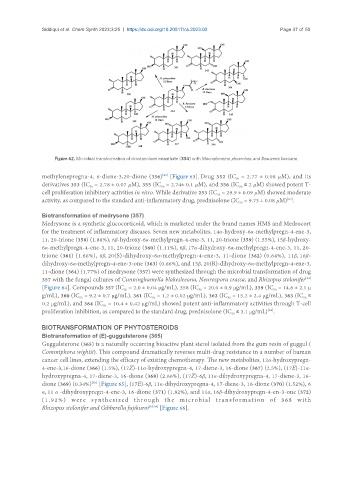
                    Figure 62. Microbial transformation of drostanolone enanthate (334) with Macrophomina phaseolina, and Beauveria bassiana.

               methylenepregna-4, 6-diene-3,20-dione (356)  [Figure 63]. Drug 352 (IC  = 2.77 ± 0.08 µM), and its
                                                        [83]
                                                                                 50
               derivatives 353 (IC  = 2.78 ± 0.07 µM), 355 (IC  = 2.74± 0.1 µM), and 356 (IC  ≤ 2 µM) showed potent T-
                                                                                  50
                                                       50
                               50
               cell proliferation inhibitory activities in vitro. While derivative 253 (IC  = 29.9 ± 0.09 µM) showed moderate
                                                                          50
               activity, as compared to the standard anti-inflammatory drug, prednisolone (IC  = 9.73 ± 0.08 µM) .
                                                                                                  [83]
                                                                                  50
               Biotransformation of medrysone (357)
               Medrysone is a synthetic glucocorticoid, which is marketed under the brand names HMS and Medrocort
               for the treatment of inflammatory diseases. Seven new metabolites, 14α-hydroxy-6α-methylpregn-4-ene-3,
               11, 20-trione (358) (1.88%), 6β-hydroxy-6α-methylpregn-4-ene-3, 11, 20-trione (359) (1.55%), 15β-hydroxy-
               6α-methylpregn-4-ene-3, 11, 20-trione (360) (1.11%), 6β, 17α-dihydroxy-6α-methylpregn-4-ene-3, 11, 20-
               trione (361) (1.66%), 6β, 20(S)-dihydroxy-6α-methylpregn-4-ene-3, 11-dione (362) (0.64%), 11β, 16β-
               dihydroxy-6α-methylpregn-4-ene-3-one (363) (0.66%), and 15β, 20(R)-dihydroxy-6α-methylpregn-4-ene-3,
               11-dione (364) (1.77%) of medrysone (357) were synthesized through the microbial transformation of drug
                                                                                                        [84]
               357 with the fungal cultures of Cunninghamella blakesleeana, Neurospora crassa, and Rhizopus stolonifer
               [Figure 64]. Compounds 357 (IC  = 2.0 ± 0.04 μg/mL), 358 (IC  = 20.0 ± 0.9 μg/mL), 359 (IC  = 14.6 ± 2.1 μ
                                                                                             50
                                           50
                                                                    50
               g/mL), 360 (IC  = 9.2 ± 0.7 μg/mL), 361 (IC  = 1.2 ± 0.02 μg/mL), 362 (IC  = 15.2 ± 2.4 μg/mL), 363 (IC  ≤
                                                    50
                            50
                                                                                                       50
                                                                              50
               0.2 μg/mL), and 364 (IC  = 10.4 ± 0.42 μg/mL) showed potent anti-inflammatory activities through T-cell
                                    50
               proliferation inhibition, as compared to the standard drug, prednisolone (IC  ≤ 3.1 μg/mL) .
                                                                                           [84]
                                                                               50
               BIOTRANSFORMATION OF PHYTOSTEROIDS
               Biotransformation of (E)-guggulsterone (365)
               Guggulsterone (365) is a naturally occurring bioactive plant sterol isolated from the gum resin of guggul (
               Commiphora wightii). This compound dramatically reverses multi-drug resistance in a number of human
               cancer cell lines, extending the efficacy of existing chemotherapy. The new metabolites, 12α-hydroxypregn-
               4-ene-3,16-dione (366) (1.5%), (17Z)-11α-hydroxypregna-4, 17-diene-3, 16-dione (367) (2.5%), (17E)-11α-
               hydroxypregna-4, 17-diene-3, 16-dione (368) (2.66%), (17Z)-6β, 11α-dihydroxypregna-4, 17-diene-3, 16-
               dione (369) (0.34%)  [Figure 65], (17E)-6β, 11α-dihydroxypregna-4, 17-diene-3, 16-dione (370) (1.52%), 6
                                [85]
               α, 11 α -dihydroxypregn-4-ene-3, 16-dione (371) (1.82%), and 11α, 16β-dihydroxypregn-4-en-3-one (372)
               ( 1 . 9 2 % )   w e r e   s y n t h e s i z e d   t h r o u g h   t h e   m i c r o b i a l   t r a n s f o r m a t i o n   o f   3 6 5   w i t h
               Rhizopus stolonifer and Gibberella fujikuroi [85,86]  [Figure 66].

