


Page 93 - Read Online
P. 93
Siddiqui et al. Chem Synth 2023;3:25  https://dx.doi.org/10.20517/cs.2023.02    Page 39 of 50


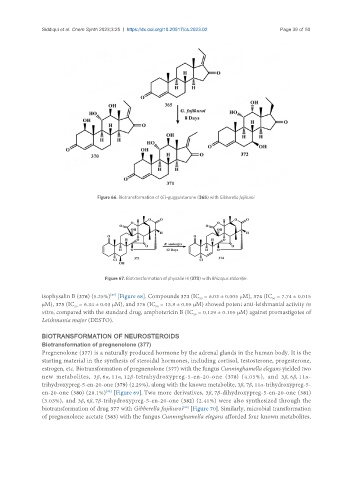
                                  Figure 66. Biotransformation of (E)-guggulsterone (365) with Gibberella fujikuroi.


                                    Figure 67. Biotransformation of physalin H (373) with Rhizopus stolonifer.


               isophysalin B (376) (5.25%)  [Figure 68]. Compounds 373 (IC  = 6.03 ± 0.005 μM), 374 (IC  = 7.74 ± 0.015
                                      [87]
                                                                    50
                                                                                             50
               μM), 375 (IC  = 6.34 ± 0.03 μM), and 376 (IC  = 13.8 ± 0.05 μM) showed potent anti-leishmanial activity in
                          50
                                                     50
               vitro, compared with the standard drug, amphotericin B (IC  = 0.129 ± 0.105 μM) against promastigotes of
                                                                  50
               Leishmania major (DESTO).
               BIOTRANSFORMATION OF NEUROSTEROIDS
               Biotransformation of pregnenolone (377)
               Pregnenolone (377) is a naturally produced hormone by the adrenal glands in the human body. It is the
               starting material in the synthesis of steroidal hormones, including cortisol, testosterone, progesterone,
               estrogen, etc. Biotransformation of pregnenolone (377) with the fungus Cunninghamella elegans yielded two
               new  metabolites,  3β, 6α, 11α, 12β-tetrahydroxypreg-5-en-20-one  (378)  (4.05%),  and  3β, 6β, 11α-
               trihydroxypreg-5-en-20-one (379) (2.29%), along with the known metabolite, 3β, 7β, 11α-trihydroxypreg-5-
               en-20-one (380) (28.1%)  [Figure 69]. Two more derivatives, 3β, 7β-dihydroxypreg-5-en-20-one (381)
                                     [88]
               (3.03%), and 3β, 6β, 7β-trihydroxypreg-5-en-20-one (382) (2.41%) were also synthesized through the
               biotransformation of drug 377 with Gibberella fujikuroi  [Figure 70]. Similarly, microbial transformation
                                                               [88]
               of pregnenolone acetate (383) with the fungus Cunninghamella elegans afforded four known metabolites,

