


Page 107 - Read Online
P. 107
Li et al. Cancer Drug Resist. 2025;8:31 Page 13 of 26
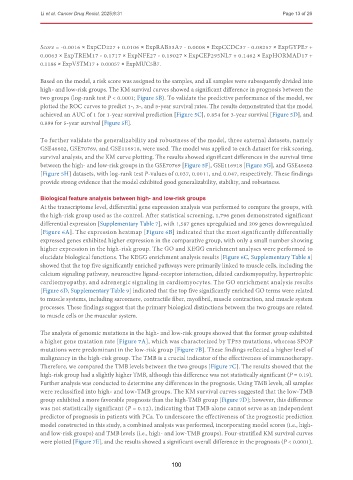
Score = -0.0016 × ExpCD227 + 0.0106 × ExpRAB33A7 - 0.0008 × ExpCCDC37 - 0.08257 × ExpGYPE7 +
0.0063 × ExpTREM17 - 0.1717 × ExpNFE27 - 0.19027 × ExpCEP295NL7 + 0.1462 × ExpHORMAD17 +
0.1186 × ExpVSTM17 + 0.00057 × ExpMUC5B7.
Based on the model, a risk score was assigned to the samples, and all samples were subsequently divided into
high- and low-risk groups. The KM survival curves showed a significant difference in prognosis between the
two groups (log-rank test P < 0.0001; Figure 5B). To validate the predictive performance of the model, we
plotted the ROC curves to predict 1-, 3-, and 5-year survival rates. The results demonstrated that the model
achieved an AUC of 1 for 1-year survival prediction [Figure 5C], 0.854 for 3-year survival [Figure 5D], and
0.889 for 5-year survival [Figure 5E].
To further validate the generalizability and robustness of the model, three external datasets, namely
GSE46602, GSE70769, and GSE116918, were used. The model was applied to each dataset for risk scoring,
survival analysis, and the KM curve plotting. The results showed significant differences in the survival time
between the high- and low-risk groups in the GSE70769 [Figure 5F], GSE116918 [Figure 5G], and GSE46602
[Figure 5H] datasets, with log-rank test P-values of 0.037, 0.0011, and 0.047, respectively. These findings
provide strong evidence that the model exhibited good generalizability, stability, and robustness.
Biological feature analysis between high- and low-risk groups
At the transcriptome level, differential gene expression analysis was performed to compare the groups, with
the high-risk group used as the control. After statistical screening, 1,796 genes demonstrated significant
differential expression [Supplementary Table 7], with 1,587 genes upregulated and 209 genes downregulated
[Figure 6A]. The expression heatmap [Figure 6B] indicated that the most significantly differentially
expressed genes exhibited higher expression in the comparative group, with only a small number showing
higher expression in the high-risk group. The GO and KEGG enrichment analyses were performed to
elucidate biological functions. The KEGG enrichment analysis results [Figure 6C, Supplementary Table 8]
showed that the top five significantly enriched pathways were primarily linked to muscle cells, including the
calcium signaling pathway, neuroactive ligand-receptor interaction, dilated cardiomyopathy, hypertrophic
cardiomyopathy, and adrenergic signaling in cardiomyocytes. The GO enrichment analysis results
[Figure 6D, Supplementary Table 9] indicated that the top five significantly enriched GO terms were related
to muscle systems, including sarcomere, contractile fiber, myofibril, muscle contraction, and muscle system
processes. These findings suggest that the primary biological distinctions between the two groups are related
to muscle cells or the muscular system.
The analysis of genomic mutations in the high- and low-risk groups showed that the former group exhibited
a higher gene mutation rate [Figure 7A], which was characterized by TP53 mutations, whereas SPOP
mutations were predominant in the low-risk group [Figure 7B]. These findings reflected a higher level of
malignancy in the high-risk group. The TMB is a crucial indicator of the effectiveness of immunotherapy.
Therefore, we compared the TMB levels between the two groups [Figure 7C]. The results showed that the
high-risk group had a slightly higher TMB, although this difference was not statistically significant (P = 0.19).
Further analysis was conducted to determine any differences in the prognosis. Using TMB levels, all samples
were reclassified into high- and low-TMB groups. The KM survival curves suggested that the low-TMB
group exhibited a more favorable prognosis than the high-TMB group [Figure 7D]; however, this difference
was not statistically significant (P = 0.12), indicating that TMB alone cannot serve as an independent
predictor of prognosis in patients with PCa. To underscore the effectiveness of the prognostic prediction
model constructed in this study, a combined analysis was performed, incorporating model scores (i.e., high-
and low-risk groups) and TMB levels (i.e., high- and low-TMB groups). Four-stratified KM survival curves
were plotted [Figure 7E], and the results showed a significant overall difference in the prognosis (P < 0.0001).
100

