


Page 153 - Read Online
P. 153
Ding et al. Soft Sci. 2026, 6, 2                                                 Page 11 of 15


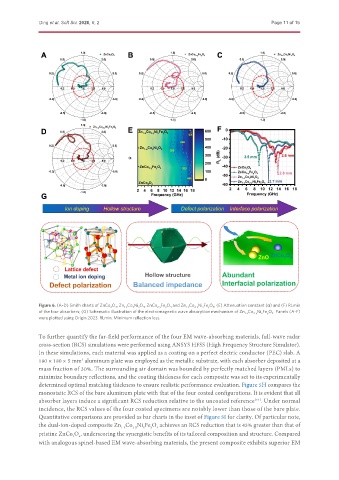
               Figure 6. (A-D) Smith charts of ZnCo 2 O 4 , Zn 1-x Co 2 Ni x O 4 , ZnCo 2-y Fe y O 4  and Zn 1-x Co 2-y Ni x Fe y O 4 ; (E) Attenuation constant (α) and (F) RLmin
               of the four absorbers; (G) Schematic illustration of the electromagnetic wave absorption mechanism of Zn 1-x Co 2-y Ni x Fe y O 4 . Panels (A-F)
               were plotted using Origin 2023. RLmin: Minimum reflection loss.


               To further quantify the far-field performance of the four EM wave-absorbing materials, full-wave radar
               cross-section (RCS) simulations were performed using ANSYS HFSS (High Frequency Structure Simulator).
               In these simulations, each material was applied as a coating on a perfect electric conductor (PEC) slab. A
               180 × 180 × 5 mm  aluminum plate was employed as the metallic substrate, with each absorber deposited at a
                              3
               mass fraction of 30%. The surrounding air domain was bounded by perfectly matched layers (PMLs) to
               minimize boundary reflections, and the coating thickness for each composite was set to its experimentally
               determined optimal matching thickness to ensure realistic performance evaluation. Figure 5H compares the
               monostatic RCS of the bare aluminum plate with that of the four coated configurations. It is evident that all
               absorber layers induce a significant RCS reduction relative to the uncoated reference . Under normal
                                                                                          [53]
               incidence, the RCS values of the four coated specimens are notably lower than those of the bare plate.
               Quantitative comparisons are provided as bar charts in the inset of Figure 5I for clarity. Of particular note,
               the dual-ion-doped composite Zn Co Ni Fe O  achieves an RCS reduction that is 43% greater than that of
                                                   x
                                                2-y
                                                        4
                                                      y
                                            1-x
               pristine ZnCo O , underscoring the synergistic benefits of its tailored composition and structure. Compared
                           2
                             4
               with analogous spinel-based EM wave-absorbing materials, the present composite exhibits superior EM

