


Page 150 - Read Online
P. 150
Page 8 of 15                                                          Ding et al. Soft Sci. 2026, 6, 2


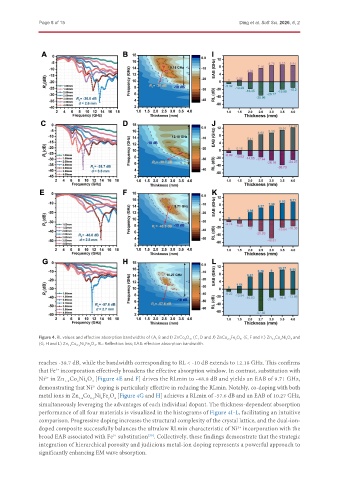
               Figure 4. RL values and effective absorption bandwidths of (A, B and I) ZnCo 2 O 4 , (C, D and J) ZnCo 2-y Fe y O 4 , (E, F and K) Zn 1-x Co 2 Ni x O 4  and
               (G, H and L) Zn 1-x Co 2-y Ni x Fe y O 4 . RL: Reflection loss; EAB: effective absorption bandwidth.

               reaches -38.7 dB, while the bandwidth corresponding to RL < -10 dB extends to 12.18 GHz. This confirms
               that Fe  incorporation effectively broadens the effective absorption window. In contrast, substitution with
                     3+
               Ni  in Zn Co Ni O  [Figure 4E and F] drives the RLmin to -48.8 dB and yields an EAB of 9.71 GHz,
                 2+
                            2
                        1-x
                                 4
                               x
               demonstrating that Ni  doping is particularly effective in reducing the RLmin. Notably, co-doping with both
                                 2+
               metal ions in Zn Co Ni Fe O  [Figure 4G and H] achieves a RLmin of -57.6 dB and an EAB of 10.27 GHz,
                                 2-y
                             1-x
                                    x
                                       y
                                         4
               simultaneously leveraging the advantages of each individual dopant. The thickness-dependent absorption
               performance of all four materials is visualized in the histograms of Figure 4I-L, facilitating an intuitive
               comparison. Progressive doping increases the structural complexity of the crystal lattice, and the dual-ion-
               doped composite successfully balances the ultralow RLmin characteristic of Ni  incorporation with the
                                                                                    2+
               broad EAB associated with Fe  substitution . Collectively, these findings demonstrate that the strategic
                                                     [39]
                                         3+
               integration of hierarchical porosity and judicious metal-ion doping represents a powerful approach to
               significantly enhancing EM wave absorption.

