


Page 147 - Read Online
P. 147
Ding et al. Soft Sci. 2026, 6, 2                                                  Page 5 of 15


               during the doping process. This observation confirms the exsolution of a secondary ZnO phase during the
               doping process. High-resolution energy-dispersive X-ray spectroscopic (EDS) elemental mapping further
               clarifies the spatial distribution of Zn, Co, O, and the dopant metals (Ni/Fe). Post-doping, localized
               enrichment of Zn and O leads to the formation of discrete crystallites that form coherent, atomically sharp
               interfaces with the ZnCo O  matrix. These atomically abrupt hetero-interfaces generate abundant interfacial
                                    2
                                      4
               polarization centers, which are expected to significantly enhance EM wave attenuation .
                                                                                       [27]
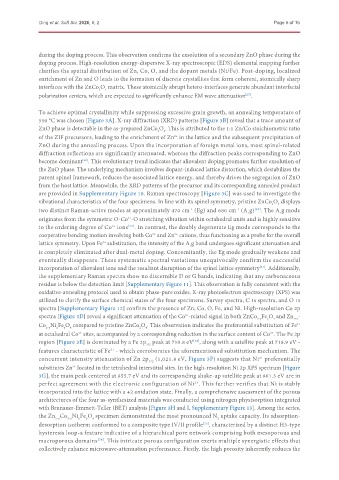
               To achieve optimal crystallinity while suppressing excessive grain growth, an annealing temperature of
               550 °C was chosen [Figure 3A]. X-ray diffraction (XRD) patterns [Figure 3B] reveal that a trace amount of
               ZnO phase is detectable in the as-prepared ZnCo O . This is attributed to the 1:1 Zn/Co stoichiometric ratio
                                                        2
                                                           4
               of the ZIF precursors, leading to the enrichment of Zn  in the lattice and the subsequent precipitation of
                                                              2+
               ZnO during the annealing process. Upon the incorporation of foreign metal ions, most spinel-related
               diffraction reflections are significantly attenuated, whereas the diffraction peaks corresponding to ZnO
               become dominant . This evolutionary trend indicates that aliovalent doping promotes further exsolution of
                              [28]
               the ZnO phase. The underlying mechanism involves dopant-induced lattice distortion, which destabilizes the
               parent spinel framework, reduces the associated lattice energy, and thereby drives the segregation of ZnO
               from the host lattice. Meanwhile, the XRD patterns of the precursor and its corresponding annealed product
               are provided in Supplementary Figure 10. Raman spectroscopy [Figure 3C] was used to investigate the
               vibrational characteristics of the four specimens. In line with its spinel symmetry, pristine ZnCo O  displays
                                                                                                2
                                                                                                   4
               two distinct Raman-active modes at approximately 470 cm  (Eg) and 680 cm  (A g) . The A g mode
                                                                                          [29]
                                                                                    -1
                                                                    -1
                                                                                                   1
                                                                                        1
               originates from the symmetric O-Co -O stretching vibration within octahedral units and is highly sensitive
                                              3+
               to the ordering degree of Co  ions . In contrast, the doubly degenerate Eg mode corresponds to the
                                              [30]
                                        3+
               cooperative bending motion involving both Co  and Zn  cations, thus functioning as a probe for the overall
                                                              2+
                                                       3+
               lattice symmetry. Upon Fe  substitution, the intensity of the A g band undergoes significant attenuation and
                                     3+
                                                                    1
               is completely eliminated after dual-metal doping. Concomitantly, the Eg mode gradually weakens and
               eventually disappears. These systematic spectral variations unequivocally confirm the successful
               incorporation of aliovalent ions and the resultant disruption of the spinel lattice symmetry . Additionally,
                                                                                            [31]
               the supplementary Raman spectra show no discernible D or G bands, indicating that any carbonaceous
               residue is below the detection limit [Supplementary Figure 11]. This observation is fully consistent with the
               oxidative-annealing protocol used to obtain phase-pure oxides. X-ray photoelectron spectroscopy (XPS) was
               utilized to clarify the surface chemical states of the four specimens. Survey spectra, C 1s spectra, and O 1s
               spectra [Supplementary Figure 12] confirm the presence of Zn, Co, O, Fe, and Ni. High-resolution Co 2p
               spectra [Figure 3D] reveal a significant attenuation of the Co -related signal in both ZnCo Fe O  and Zn -
                                                                  3+
                                                                                                 4
                                                                                                        1‑x
                                                                                               y
                                                                                           2-y
               Co Ni Fe O  compared to pristine ZnCo O . This observation indicates the preferential substitution of Fe 3+
                                                    4
                                                  2
                     x
                       y
                          4
                 2-y
               at octahedral Co  sites, accompanied by a corresponding reduction in the surface content of Co . The Fe 2p
                                                                                                3+
                             3+
               region [Figure 3E] is dominated by a Fe 2p  peak at 710.8 eV , along with a satellite peak at 718.9 eV -
                                                                     [32]
                                                    3/2
               features characteristic of Fe  - which corroborates the aforementioned substitution mechanism. The
                                        3+
               concurrent intensity attenuation of Zn 2p  (1,021.8 eV, Figure 3F) suggests that Ni  preferentially
                                                                                            2+
                                                     3/2
               substitutes Zn  located in the tetrahedral interstitial sites. In the high-resolution Ni 2p XPS spectrum [Figure
                          2+
               3G], the main peak centered at 855.7 eV and its corresponding shake-up satellite peak at 861.3 eV are in
               perfect agreement with the electronic configuration of Ni . This further verifies that Ni is stably
                                                                     2+
               incorporated into the lattice with a +2 oxidation state. Finally, a comprehensive assessment of the porous
               architectures of the four as-synthesized materials was conducted using nitrogen physisorption integrated
               with Brunauer-Emmett-Teller (BET) analysis [Figure 3H and I, Supplementary Figure 13]. Among the series,
               the Zn Co Ni Fe O  specimen demonstrated the most pronounced N  uptake capacity. Its adsorption-
                    1-x
                             x
                                 4
                               y
                                                                             2
                         2-y
               desorption isotherm conformed to a composite type IV/II profile , characterized by a distinct H3-type
                                                                        [33]
               hysteresis loop-a feature indicative of a hierarchical pore network comprising both mesoporous and
               macroporous domains . This intricate porous configuration exerts multiple synergistic effects that
                                   [34]
               collectively enhance microwave-attenuation performance. Firstly, the high porosity inherently reduces the

