


Page 158 - Read Online
P. 158
Review Article | Open Access
Soft Science
Wang et al. Soft Sci. 2026, 6, 8 DOI:10.20517/ss.2025.98
Recent advances in carbon-based microwave-
absorbing aerogel
Kaifeng Wang , Wenshuang Chu , Xinke Liu , Xiaohua Li , Hezhou Liu 1
1,*
1
1
2
Keywords:
Microwave absorption,
carbon-based aerogel,
porous structure,
construction methods
Citation: Wang, K.;
Chu, W.; Liu, X.; Li, X.; Liu, H.
Recent advances in
carbon-based
microwave-absorbing
aerogel. Soft Sci. 2026, 6, 8.
https://dx.doi.org/10.20517
/ss.2025.98
Received: 30 Sep 2025
First Decision: 11 Nov
2025
Revised: 8 Dec 2025 Abstract
Accepted: 19 Dec 2025
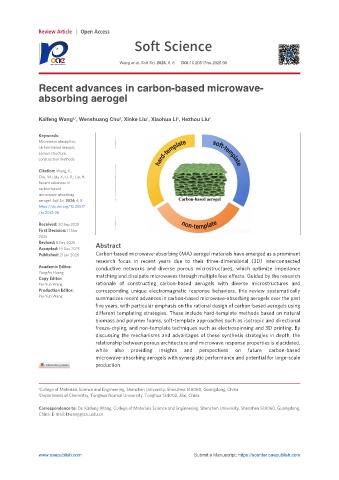
Published: 21 Jan 2026 Carbon-based microwave-absorbing (MA) aerogel materials have emerged as a prominent
research focus in recent years due to their three-dimensional (3D) interconnected
Academic Editor: conductive networks and diverse porous microstructures, which optimize impedance
YongAn Huang matching and dissipate microwaves through multiple loss effects. Guided by the research
Copy Editor:
Pei-Yun Wang rationale of constructing carbon-based aerogels with diverse microstructures and
Production Editor: corresponding unique electromagnetic response behaviors, this review systematically
Pei-Yun Wang summarizes recent advances in carbon-based microwave-absorbing aerogels over the past
five years, with particular emphasis on the rational design of carbon-based aerogels using
different templating strategies. These include hard-template methods based on natural
biomass and polymer foams, soft-template approaches such as isotropic and directional
freeze-drying, and non-template techniques such as electrospinning and 3D printing. By
discussing the mechanisms and advantages of these synthesis strategies in depth, the
relationship between porous architecture and microwave response properties is elucidated,
while also providing insights and perspectives on future carbon-based
microwave-absorbing aerogels with synergistic performance and potential for large-scale
production.
1 College of Materials Science and Engineering, Shenzhen University, Shenzhen 518060, Guangdong, China.
2 Department of Chemistry, Tonghua Normal University, Tonghua 134002, Jilin, China.
Correspondence to: Dr. Kaifeng Wang, College of Materials Science and Engineering, Shenzhen University, Shenzhen 518060, Guangdong,
China. E-mail: kfwang@szu.edu.cn
www.oaepublish.com Submit a Manuscript: https://ucenter.oaepublish.com

