


Page 161 - Read Online
P. 161
Page 4 of 28                                                         Wang et al. Soft Sci. 2026, 6, 8


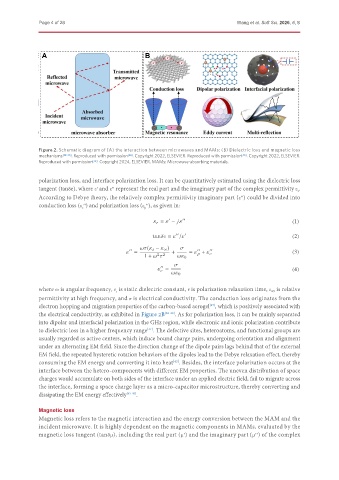
               Figure 2. Schematic diagram of (A) the interaction between microwaves and MAMs; (B) Dielectric loss and magnetic loss
               mechanisms [38-40] . Reproduced with permission [38] . Copyright 2022, ELSEVIER. Reproduced with permission [40] . Copyright 2022, ELSEVIER.
               Reproduced with permission [39] . Copyright 2024, ELSEVIER. MAMs: Microwave-absorbing materials.

               polarization loss, and interface polarization loss. It can be quantitatively estimated using the dielectric loss
               tangent (tanδe), where ε′ and ε′′ represent the real part and the imaginary part of the complex permittivity ε . r
               According to Debye theory, the relatively complex permittivity imaginary part (ε′′) could be divided into
               conduction loss (ε ′′) and polarization loss (ε ′′), as given in:
                                                    p
                              c
                                                             =    −      ′′                             (1)
                                                            ′
                                                       tan  e =    /   ′                                (2)
                                                               ′′
                                                      (      −    ∞ )
                                                                      ′′
                                              ′′
                                                =            +     =    +    ′′                         (3)


                                                    1 +             0
                                                        2 2

                                                         ′′
                                                           =                                            (4)

                                                                  0
               where ω is angular frequency, ε  is static dielectric constant, τ is polarization relaxation time, ε  is relative
                                                                                                ∞
                                          s
               permittivity at high frequency, and σ is electrical conductivity. The conduction loss originates from the
               electron hopping and migration properties of the carbon-based aerogel , which is positively associated with
                                                                           [37]
               the electrical conductivity, as exhibited in Figure 2B [38-40] . As for polarization loss, it can be mainly separated
               into dipolar and interfacial polarization in the GHz region, while electronic and ionic polarization contribute
               to dielectric loss in a higher frequency range . The defective sites, heteroatoms, and functional groups are
                                                     [41]
               usually regarded as active centers, which induce bound charge pairs, undergoing orientation and alignment
               under an alternating EM field. Since the direction change of the dipole pairs lags behind that of the external
               EM field, the repeated hysteretic rotation behaviors of the dipoles lead to the Debye relaxation effect, thereby
               consuming the EM energy and converting it into heat . Besides, the interface polarization occurs at the
                                                              [42]
               interface between the hetero-components with different EM properties. The uneven distribution of space
               charges would accumulate on both sides of the interface under an applied electric field, fail to migrate across
               the interface, forming a space charge layer as a micro-capacitor microstructure, thereby converting and
               dissipating the EM energy effectively [43-45] .


               Magnetic loss
               Magnetic loss refers to the magnetic interaction and the energy conversion between the MAM and the
               incident microwave. It is highly dependent on the magnetic components in MAMs, evaluated by the
               magnetic loss tangent (tanδμ), including the real part (μ′) and the imaginary part (μ′′) of the complex

