


Page 166 - Read Online
P. 166
Wang et al. Soft Sci. 2026, 6, 8                                                  Page 9 of 28


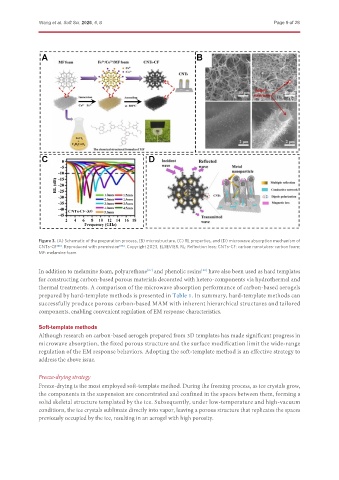
               Figure 3. (A) Schematic of the preparation process, (B) microstructure, (C) RL properties, and (D) microwave absorption mechanism of
               CNTs-CF [86] . Reproduced with permission [86] . Copyright 2023, ELSEVIER. RL: Reflection loss; CNTs-CF: carbon nanotubes-carbon foam;
               MF: melamine foam.

               In addition to melamine foam, polyurethane  and phenolic resins  have also been used as hard templates
                                                     [87]
                                                                        [88]
               for constructing carbon-based porous materials decorated with hetero-components via hydrothermal and
               thermal treatments. A comparison of the microwave absorption performance of carbon-based aerogels
               prepared by hard-template methods is presented in Table 1. In summary, hard-template methods can
               successfully produce porous carbon-based MAM with inherent hierarchical structures and tailored
               components, enabling convenient regulation of EM response characteristics.


               Soft-template methods
               Although research on carbon-based aerogels prepared from 3D templates has made significant progress in
               microwave absorption, the fixed porous structure and the surface modification limit the wide-range
               regulation of the EM response behaviors. Adopting the soft-template method is an effective strategy to
               address the above issue.


               Freeze-drying strategy
               Freeze-drying is the most employed soft-template method. During the freezing process, as ice crystals grow,
               the components in the suspension are concentrated and confined in the spaces between them, forming a
               solid skeletal structure templated by the ice. Subsequently, under low-temperature and high-vacuum
               conditions, the ice crystals sublimate directly into vapor, leaving a porous structure that replicates the spaces
               previously occupied by the ice, resulting in an aerogel with high porosity.

