


Page 171 - Read Online
P. 171
Page 14 of 28                                                        Wang et al. Soft Sci. 2026, 6, 8


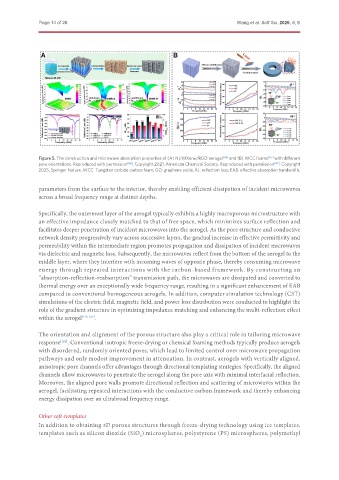
               Figure 5. The construction and microwave absorption properties of (A) Ni/MXene/RGO aerogel [116]  and (B) WCC foams [117]  with different
               pore orientations. Reproduced with permission [116] . Copyright 2021, American Chemical Society. Reproduced with permission [117] . Copyright
               2025, Springer Nature. WCC: Tungsten carbide carbon foam; GO: graphene oxide; RL: reflection loss; EAB: effective absorption bandwidth.

               parameters from the surface to the interior, thereby enabling efficient dissipation of incident microwaves
               across a broad frequency range at distinct depths.


               Specifically, the outermost layer of the aerogel typically exhibits a highly macroporous microstructure with
               an effective impedance closely matched to that of free space, which minimizes surface reflection and
               facilitates deeper penetration of incident microwaves into the aerogel. As the pore structure and conductive
               network density progressively vary across successive layers, the gradual increase in effective permittivity and
               permeability within the intermediate region promotes propagation and dissipation of incident microwaves
               via dielectric and magnetic loss. Subsequently, the microwaves reflect from the bottom of the aerogel to the
               middle layer, where they interfere with incoming waves of opposite phase, thereby consuming microwave
               energy through repeated interactions with the carbon-based framework. By constructing an
               “absorption-reflection-reabsorption” transmission path, the microwaves are dissipated and converted to
               thermal energy over an exceptionally wide frequency range, resulting in a significant enhancement of EAB
               compared to conventional homogeneous aerogels. In addition, computer simulation technology (CST)
               simulations of the electric field, magnetic field, and power loss distribution were conducted to highlight the
               role of the gradient structure in optimizing impedance matching and enhancing the multi-reflection effect
               within the aerogel [118-121] .

               The orientation and alignment of the porous structure also play a critical role in tailoring microwave
               response . Conventional isotropic freeze-drying or chemical foaming methods typically produce aerogels
                      [122]
               with disordered, randomly oriented pores, which lead to limited control over microwave propagation
               pathways and only modest improvement in attenuation. In contrast, aerogels with vertically aligned,
               anisotropic pore channels offer advantages through directional templating strategies. Specifically, the aligned
               channels allow microwaves to penetrate the aerogel along the pore axis with minimal interfacial reflection.
               Moreover, the aligned pore walls promote directional reflection and scattering of microwaves within the
               aerogel, facilitating repeated interactions with the conductive carbon framework and thereby enhancing
               energy dissipation over an ultrabroad frequency range.


               Other soft-templates
               In addition to obtaining 3D porous structures through freeze-drying technology using ice templates,
               templates such as silicon dioxide (SiO ) microspheres, polystyrene (PS) microspheres, polymethyl
                                                  2

