


Page 167 - Read Online
P. 167
Page 10 of 28                                                        Wang et al. Soft Sci. 2026, 6, 8


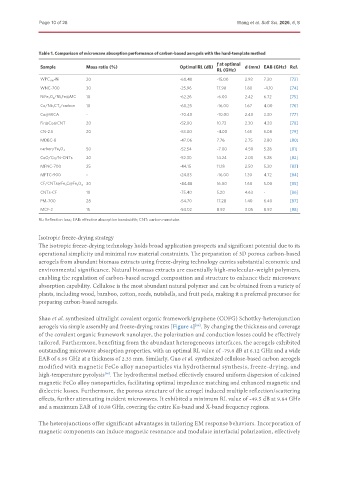
               Table 1. Comparison of microwave absorption performance of carbon-based aerogels with the hard-template method
                                                                             f at optimal
               Sample          Mass ratio (%)                   Optimal RL (dB)        d (mm) EAB (GHz) Ref.
                                                                             RL (GHz)
               WPC 700 -Ni     20                               -60.40       ~15.00    2.93   7.30     [73]
               WNC-700         30                               -25.96       17.98     1.80   -4.10    [74]
               NiFe 2 O 4 /Ni 3 Fe@MC  10                       -62.26       ~6.00     2.42   6.72     [75]
               Co/Nb 2 CT x /carbon  10                         -60.25       ~16.00    1.67   4.00     [76]
               Co@WCA          -                                -70.40       ~10.00    2.40   3.30     [77]
               Fir@Co@CNT      20                               -52.00       10.72     2.30   4.20     [78]
               CN-2.5          20                               -53.00       ~4.00     1.65   5.08     [79]
               MDBC-8                                           -47.06       7.76      2.75   2.80     [80]
                               50                               -52.54       ~7.00     4.50   5.28     [81]
               carbon/Fe 3 O 4
               CoO/Co/N-CNTs   20                               -52.30       14.24     2.00   5.28     [82]
               MFNC-700        25                               -44.15       11.18     2.50   5.30     [83]
               MFTC-900        -                                -24.83       ~16.00    1.30   4.72     [84]
               CF/CNTs@Fe 3 C@Fe 3 O 4 30                       -44.48       16.00     1.68   5.00     [85]
               CNTs-CF         10                               -75.40       5.20      4.63   -        [86]
               PM-700          28                               -54.70       17.28     1.40   6.40     [87]
               MCF-2           15                               -54.02       8.92      3.05   8.92     [88]

               RL: Reflection loss; EAB: effective absorption bandwidth; CNT: carbon nanotube.

               Isotropic freeze-drying strategy
               The isotropic freeze-drying technology holds broad application prospects and significant potential due to its
               operational simplicity and minimal raw material constraints. The preparation of 3D porous carbon-based
               aerogels from abundant biomass extracts using freeze-drying technology carries substantial economic and
               environmental significance. Natural biomass extracts are essentially high-molecular-weight polymers,
               enabling the regulation of carbon-based aerogel composition and structure to enhance their microwave
               absorption capability. Cellulose is the most abundant natural polymer and can be obtained from a variety of
               plants, including wood, bamboo, cotton, reeds, nutshells, and fruit peels, making it a preferred precursor for
               preparing carbon-based aerogels.


               Shao et al. synthesized ultralight covalent organic framework/graphene (COFG) Schottky-heterojunction
               aerogels via simple assembly and freeze-drying routes [Figure 4] . By changing the thickness and coverage
                                                                      [89]
               of the covalent organic framework nanolayer, the polarization and conduction losses could be effectively
               tailored. Furthermore, benefiting from the abundant heterogeneous interfaces, the aerogels exhibited
               outstanding microwave absorption properties, with an optimal RL value of -79.8 dB at 6.12 GHz and a wide
               EAB of 6.96 GHz at a thickness of 2.35 mm. Similarly, Guo et al. synthesized cellulose-based carbon aerogels
               modified with magnetic FeCo alloy nanoparticles via hydrothermal synthesis, freeze-drying, and
               high-temperature pyrolysis . The hydrothermal method effectively ensured uniform dispersion of calcined
                                      [90]
               magnetic FeCo alloy nanoparticles, facilitating optimal impedance matching and enhanced magnetic and
               dielectric losses. Furthermore, the porous structure of the aerogel induced multiple reflection/scattering
               effects, further attenuating incident microwaves. It exhibited a minimum RL value of -49.5 dB at 9.84 GHz
               and a maximum EAB of 10.88 GHz, covering the entire Ku-band and X-band frequency regions.


               The heterojunctions offer significant advantages in tailoring EM response behaviors. Incorporation of
               magnetic components can induce magnetic resonance and modulate interfacial polarization, effectively

