


Page 162 - Read Online
P. 162
Wang et al. Soft Sci. 2026, 6, 8                                                  Page 5 of 28


               permeability μ . The magnetic loss mechanisms mainly include resonance behaviors (natural, exchange,
                            [46]
                           r
               and domain), magnetic hysteresis, and eddy current effect . The domain wall resonance commonly
                                                                    [47]
               generates at MHz frequency region and magnetic hysteresis represents irreversible magnetization behaviors
               at higher magnetic field, which could be neglected at the GHz frequency range. The natural resonance
               behavior is influenced by the anisotropy and magnetic moment of the magnetic component within a single
               domain , whereas exchange resonance, occurring in exchange-coupled spin systems, is negatively
                      [48]
               correlated with the size of the magnetic particles and appears at higher frequency regions. Therefore, the
               magnetic loss behavior can be tailored by controlling the magnetic anisotropy of particles with different
               morphologies and crystalline structures . Besides, eddy currents also play a crucial role in converting the
                                                 [49]
               microwave energy into thermal energy due to the Joule heat effect, by generating an induced micro-current
               under alternating EM fields [50-52] , which could be evaluated as follows:

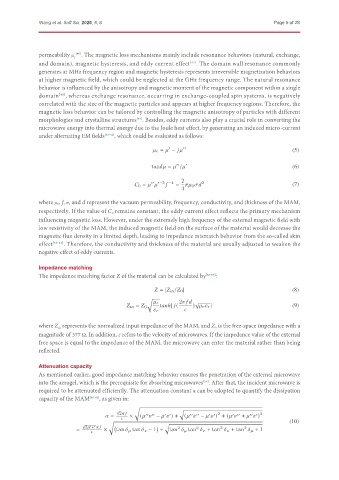
                                                             =    −      ′′                             (5)
                                                            ′

                                                               ′′
                                                      tan     =    /   ′                                (6)
                                                                 2
                                                      ′′ ′−2 −1
                                                   0 =            =       0      2                      (7)
                                                                 3
               where μ 0, f, σ, and d represent the vacuum permeability, frequency, conductivity, and thickness of the MAM,
               respectively. If the value of C 0 remains constant, the eddy current effect reflects the primary mechanism
               influencing magnetic loss. However, under the extremely high frequency of the external magnetic field with
               low resistivity of the MAM, the induced magnetic field on the surface of the material would decrease the
               magnetic flux density in a limited depth, leading to impedance mismatch behavior from the so-called skin
               effect [53-55] . Therefore, the conductivity and thickness of the material are usually adjusted to weaken the
               negative effect of eddy currents.


               Impedance matching
               The impedance matching factor Z of the material can be calculated by [56-58] :


                                                          = |        /   0 |                            (8)
                                                     r
                                                                2         √
                                                     =    0        ℎ[   (  )             ]              (9)

               where Z  represents the normalized input impedance of the MAM, and Z 0 is the free-space impedance with a
                     in
               magnitude of 377 Ω. In addition, c refers to the velocity of microwaves. If the impedance value of the external
               free space is equal to the impedance of the MAM, the microwave can enter the material rather than being
               reflected.


               Attenuation capacity
               As mentioned earlier, good impedance matching behavior ensures the penetration of the external microwave
               into the aerogel, which is the prerequisite for absorbing microwaves . After that, the incident microwave is
                                                                        [59]
               required to be attenuated efficiently. The attenuation constant α can be adopted to quantify the dissipation
               capacity of the MAM [60-62] , as given in:

                                                r
                                          √ 2                   q
                                                                                         ′′ ′ 2
                                                                          ′ ′ 2
                                         =    ×   (      −       ) +  (      −       ) + (      +       )
                                                           ′ ′
                                                                                   ′ ′′
                                                                    ′′ ′′
                                                    ′′ ′′

                                       r                                                               (10)
                              √ 2                          q
                                 ′
                                  ′
                                                                              2
                                                               2
                                                                      2
                                                                                       2
                            =        ×    tan       tan       − 1 +  tan       tan       + tan       + tan       + 1


